Showing posts with label culture. Show all posts

Saturday, March 16, 2019

Overlooked Allies?

As we attempt to link art and science to increase the power of each, ArtSciConverge encourages developing partnerships with other like-minded entities like museums, university programs, artist residencies, arts councils, and other cultural institutions.

But there may be potential allies we've been overlooking: religious organizations.

I was recently gob-smacked when a group of fundamentalist Christians disrupted a public meeting to promote a hands-off management strategy for addressing western wildfire, and to express their heartfelt belief that this was the best way to protect iconic wildlife. I didn't see that coming from a sector that, in my experience, has aggressively claimed stewardship over the Earth, and--often--an understanding that it was put here for us to use up before the Apocalypse. But it's good news for ArtSciConverge: we can work with that!

Throughout history, many religious traditions have addressed the challenge of human existence by withdrawing their practitioners from worldly life, or by adopting deeply cynical perspectives on the need to accelerate the arrival of an apocalyptic end. But, like art and science, religion can also be, and often is, used as a mechanism for understanding and shaping the world. Significant examples of religious engagement in the world's problems include:
  • Engaged Buddhism. Founder Thích Nhất Hạnh interprets Buddhism is a way of linking authentic Buddhist practice—particularly mindfulness—with social action. The western efforts are centered in Loubes-Bernac, France and Berkeley, CA. This sect identifies an explicit social ethos present in the earliest recorded Buddhist teachings, and adopts the non-violent resistance of Mahatma Gandhi and Martin Luther King. Beside Hanh's efforts, the current Dalai Lama has expressed a need for Buddhists to be more involved in the socio-political realm, stating, "Buddhists have not acted vigorously to address social and political problems. In this, we have much to learn from the Christians." Engaged Buddhism is the model for the larger Engaged spirituality, which refers to religious or spiritual people who actively engage in the world in order to transform it in positive ways while finding nurture, inspiration and guidance in their spiritual beliefs and practices.
  • Christianity has a long and checkered record of social engagement, a history that includes some of the most violent, oppressive and exploitative policies and episodes in recorded human history. Frankly, given current headlines, there is still too much of this and a long way to go to end it. But Christian organizations like the Sojourners work "to articulate the biblical call to social justice, inspiring hope and building a movement to transform individuals, communities, the church, and the world."
  • Network of Spiritual Progressives. Founded as an interfaith organization in 2005 by Rabbi Michael Lerner in Berkeley, CA, the network seeks to influence American politics towards more humane, progressive values.

Other efforts may spring from the mystical traditions of major religions, or develop Earth and nature-based spirituality (deep ecology, radical environmentalism, hallucinogen-based spirituality, etc.); these New-Age movements have often been severely criticized for lack of intellectual rigor, which rather misses the point.

Artists have not failed to notice all this. One excellent ongoing project is Reverend Billy's Church of Stop Shopping, whose Fundamentalist theatricality is twisted in service of a deep message of economic revolution.

Friday, October 12, 2018

Art, Science and Democracy...and FSMLs

"Democracy is the art and science of running the circus from the monkey cage." -- H. L. Mencken


  Democracy and Science...

"The relation of science and democracy is an ancient conundrum that continues to generate public controversy. Whenever science produces an “inconvenient truth”—as Al Gore famously calls the science of climate change—democratic governments may be tempted to ignore or suppress it. And as scientists like to remind us, 'You can’t vote on the laws of physics!'
Natural scientists and their advocates often argue that the power of science in democracy depends on it remaining insulated from politics. Seen in this light, it is no wonder that many believe science and democracy tend to undermine each other. But another long tradition sees science and democracy as mutually reinforcing. Democracies depend on science for effectively addressing public problems, and many argue that science provides a model of rational democratic deliberation.
These two conflicting interpretations each capture part of the story, but they neglect some of the most interesting questions, which concern changes in the meaning and purpose of science and democracy and how they shape each other in particular contexts. With regard to science, most scholars who study science and democracy now reject the long dominant “positivist” view of science as a formal, logical, socially insulated method for producing value-free knowledge. The ideal of value-free science remains popular in public life, but extensive research in the social sciences and humanities has shown how science is intertwined with social values, commercial pressures, and political decisions.
That does not mean science merely reflects dominant interests, as caricatures of “social constructivism” assert, but it does open up difficult questions about how democratic citizens might shape the science that shapes their lives. With regard to democracy, mid-20th-century political scientists tended to conceive democracy narrowly in terms of popular elections and formal state institutions. Recent scholarship, in contrast, shows how social institutions and material practices of all kinds may become sites of democratic politics. Indeed, as democracy has increased in global popularity, its meaning has become increasingly diffuse and ambiguous; democracy offers both a rallying cry for social justice movements and a marketing slogan for global corporations.
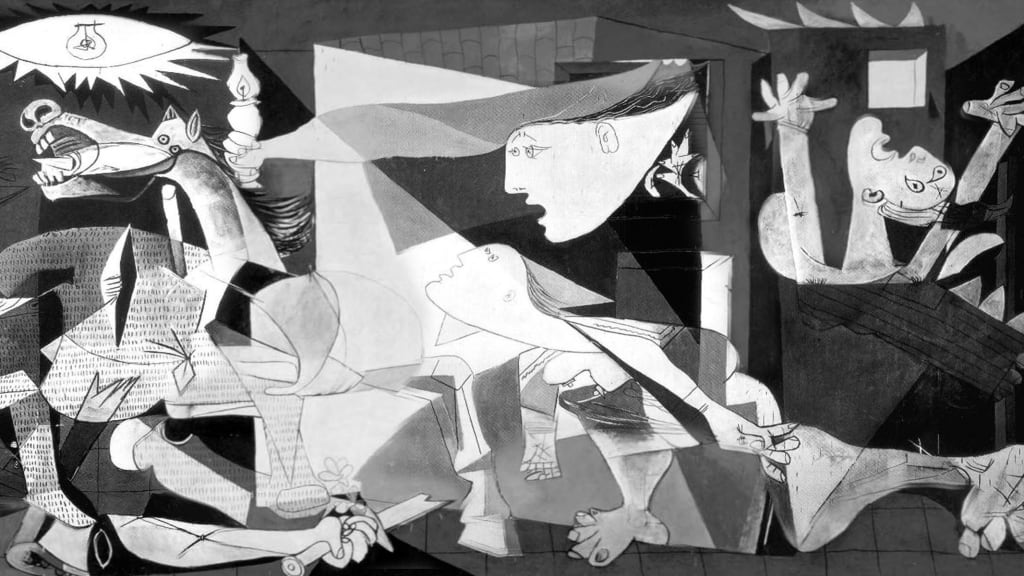
Picasso's Guernica
The relation of science and democracy involves a wide range of disparate phenomena, including science advice, science policy, public engagement in sociotechnical controversies, lay-expert relations, and the technical constitution of democratic citizens, not to mention the many specific concerns associated with issues like climate change, genetic engineering, or nanotechnology."

If science is not value-neutral, who decides how it is politicized?


Democracy and Art...

"Our leaders and institutions appear to be ill-equipped to deal with the most pressing global challenges because of particular interests that make global governance institutions weak [despite clear science]. There is a mismatch between the fragmentation of specialized institutions and the interconnectedness and complexity of today’s world.

Arts and culture have a direct bearing on our capacity to face today’s complex issues. Art safeguards a long-term view; not only does it provide a counterweight to the fast evolving world of technology, but it also helps to make sense of this world. Art invites participation and thus transcends the division between observation and activism. Art inspires insights that resonate across disciplines. Art helps to situate science and technology in public space by symbolically and reflexively representing their roles in society. Art fosters imagination and creativity, capacities that are crucial in its impact on the individual and the community."

Science, Art and Social Change...


Schubel 2015.
We need artists to bridge the gap between science's data and knowledge, to the policy that leads to cultural change. For FSMLs, this typically swirls around the Grand Challenges in Environmental Sciences.

"...unlike political consensus--once scientific consensus is reached and knowledge has been created from data, that doesn't mean there has actually been any connection made to public opinion, nor to the mechanisms of social change. Art can fill this disconnect, and has frequently been used by politicians as a tool to effect change in the working of the world."

Monday, October 8, 2018

Powerful artists

Here are some artists currently doing remarkable work at the intersection of art, environment and science. Thanks to Josh Harrison for the suggestions:

David Haley

"Ecological artist, David Haley, believes our ability to survive Climate Change is the enactment of a complex evolutionary narrative. As the dance of creation and destruction, also, demands new opportunities and meanings for the other side of collapse, his inquiries into the nature of water, whole systems ecology, complexity, and integral critical futures thinking inform his arts practice, academic research, education and community developments."

Tim Collins & Reiko Goto

"Tim Collins is an artist, author and planner, working across art, science and philosophy for over twenty years. He has worked within a wide range of communities developing research, methods and practices that take best advantage of art and aesthetics in the public interest...Over the last decade, Collins and his partner Reiko Goto have been developing artwork, tools and technologies that attend to the silent, the invisible and the different temporal relationships that occur at the scale of forests and gardens."

Jonathan Baxter

"Jonathan Baxter is an ‘artist and …’ He works across disciplines – both art and non-art related – using psychoanalytic methodologies and performative practices to variously open up, challenge and propose what is."


Lucas Ihlein 

"Ihlein is an award-winning Australian artist whose work explores the relationship between socially engaged art, agriculture and environmental management."


=================

Recommendations for artists who are compatible with field station science

Take a look at these artist's websites to see if their work resonates with yours:

"...I promised to send along the list of artists I know of who would be a great fit for a residency at a field station (and/or they may have already done something like this in the past)

Carolina Aragon

Cathleen Faubert
Helen Glazer
Ryan Griffis
Sarah Kanouse
Brian Knep
Mikhail Mansion
Jane Marsching
Lize Mogel
Teri Rueb
Brooke Singer
Joseph Smolinski
Andi Sutton

These are some that are at the top of mind at the moment, but I could certainly come up with more if folks are interested.

Best wishes,

Catherine D'Ignazio

Assistant Professor, Emerson College
Senior Fellow, Emerson Engagement Lab
Research Affiliate, MIT Center for Civic Media
@kanarinka | www.kanarinka.com | 617-501-2441"

Thursday, October 4, 2018

Festival for the Earth


ABOUT FESTIVAL FOR THE EARTH

Festival for the Earth is a 2-day international gathering proposing...transformations, reflections and alternative modalities to reframe environmental issues.

Knowledge access and information flows are highly important as actual environmental emergencies urge a radical change of perspective and practices. To this end, the Festival for the Earth is conceived by the artist Maria Rebecca Ballestra as an art project for social transformation that aims to instigate creativeness directed at positive transformation processes in science, humanities, economy, ecology and art.

The conference’s location alternates between Venice and the Principality of Monaco, two cities that are already linked by strong historical ties, two symbolic places where the relationship between “water” and land (characterized by its scarcity) has shaped both the minds of their citizens and their history. In December 2018 the Festival’s third edition will return to Venice and will be hosted in the prestigious locations of Ca’ Foscari University Venice, Ateneo Veneto, the Natural History Museum of Venice and the Botanical Garden of Padova.

For more information about the Festival and requests for interviews:

Stefania Pensabene
+39 335 724 94 29
press@festivalfortheearth.com
www.festivalfortheearth.com
twitter: @Ffortheearth – istagram: ffortheearth – facebook: Festivalfortheearth

Monaco, 04 October 2018 – Festival for the Earth comes back to the most famous lagoon in the world for its 2018 edition, with a wide range of conferences, workshops, artist talks and events to be held in different locations around Venice on December 3 and 4.  In its third edition, however, the Festival will also expand its reach to the Botanical Garden of Padua, one of the most ancient and beautiful in the world, which will host film projections and discussions at its Auditorium.

Once again, Festival’s guest speakers will come from the top of the academia and professional world (Nobel, Pulitzer and Goldman Prize Winners will join us in Venice), but also members of influential international organizations. We are honored to announce that HSH Prince Albert II of Monaco and Mr. Youba Sokona, UN’s Intergovernmental Panel on Climate Change (IPCC) Vice-Chair will give the opening speeches of the Festival, followed among others by world renowned climatologist Nigel Tapper, who contributed to the IPCC study that resulted in the joint award of the Nobel Prize to Al Gore and the IPCC, by Pulitzer Prize Daniel Fagin and by Goldman Prize Rossano Ercolini.

Wednesday, July 4, 2018

Advancing "One Water" Through Arts and Culture: A Blueprint for Action


"The US Water Alliance believes that arts and culture can move the needle for One Water management—an approach to water management that is inclusive and integrated to ensure a sustainable water future for future generations...

The urgent and multifaceted nature of our water challenges calls for new ways of thinking, acting, and investing. Water leaders across the nation are embracing the One Water approach—managing water resources in a more integrated, inclusive, and sustainable manner in order to secure a bright and prosperous future for our children, communities, and country.

ArtPlace America and the US Water Alliance believe there is tremendous opportunity to utilize arts and culture strategies to advance One Water. As creative thinkers and doers, artists can be powerful partners for water leaders seeking to reimagine traditional approaches to water planning and management and connect with communities in new ways.

Our partnership has been a collaboration in the finest sense of the word. Together we learned about each other’s sectors, challenged assumptions, and have developed a powerful framework for how to use arts and culture to forge One Water progress. We are so inspired by the creative ways that utilities, environmental groups, public agencies, and other water practitioners are collaborating with artists and cultural leaders. But it is only the beginning."
Read the full report here

Wednesday, May 16, 2018

Long-awaited paper now out

The Integration of the Humanities and Artswith Sciences, Engineering, and Medicine inHigher Education: Branches from the Same Tree (read online, or order a hard copy).

The National Academy of Sciences commissioned this report on the value of STEMM integration in higher education. From a highlights document:
"This study examined an important trend in higher education: integration of the humanities and arts with sciences, engineering, and medicine at the undergraduate and graduate level—which proponents argue will better prepare students for work, life, and citizenship...This movement in higher education raises an important question: what impact do these curricular approaches have on students? 
To address this question, the National Academies of Sciences, Engineering, and Medicine formed a 22-member committee to examine 'the evidence behind the assertion that educational programs that mutually integrate learning experiences in the humanities and arts with science, technology, engineering, mathematics, and medicine (STEMM) lead to improved educational and career outcomes for undergraduate and graduate students.' The committee conducted an in-depth review and analysis of the state of knowledge on the impact of integrative approaches on students."
 The results are encouraging:
"Aggregate evidence indicates that some approaches that integrate the humanities and arts with STEMM are associated with positive learning outcomes. Among the outcomes reported are increased critical thinking abilities, higher-order thinking and deeper learning, content mastery, problem solving, teamwork and communication skills, improved visuospatial reasoning, and general engagement and enjoyment of learning. 
An important observation was that the kinds of outcomes associated with certain integrative approaches in higher education are the educational outcomes that many employers presently seek. Employer surveys consistently show that employers want well-rounded individuals with a holistic education who can take on complex problems and understand the needs, desires, and motivations of others. Importantly, these learning goals and competences are similarly valued by institutions of higher education. The committee considered multiple forms of evidence as it developed the following recommendations for institutions, faculty, administrators, scholars of higher education, and federal and private funders. The recommendations fall under four main areas:"

  1. Support for Integrative Approaches
  2. Evaluating Integrative Courses and Programs
  3. Enhancing Inclusivity Through Integrative Courses and Programs
  4. Removing the Barriers to Integrative Approaches 
The paper concludes that:
"Higher education should strive to offer all students—regardless of degree or area of concentration—an education that exposes them to diverse forms of human knowledge and inquiry and that impresses upon them the fact that all disciplines are 'branches of the same tree.' Such an education should empower students to understand the fundamental connections among the diverse branches of human inquiry—the arts, humanities, sciences, social sciences, mathematics, engineering, technology, and medicine."

Saturday, April 28, 2018

“What would power look like if it were art?”

Jim Mason is a Burning Man and San Francisco Bay area artist. Asking that question led Mason down a path that led to All Power Labs (APL), a $5M a year energy start up sustained entirely by sales.

APL creates biomass gasifiers that produce heat, electricity and biochar from organic debris, creating negative carbon balance in the equation. The company actually aims to reverse the planetary damage done by burning fossil fuels over the past 150 years, moving atmospheric carbon into the soil in a stable form that enhances soil productivity over millennia. The technology is small scale for distributed production at the source of the feedstock, rather than requiring trucking of material to a large megawatt generator, as is our current cultural model...which is only better because some company can make billions that way.

Though APL's aims seem grandiose to the point of delusion, the artists are onto what may be the only solution out there, and the company is growing rapidly both domestically and world-wide.

APL's gasifiers are small, arriving on a pallet, and relatively affordable (if you have $50K and a handy source of biomass to feed it). But now, anyone can get in on the action, and improve their garden (or someone else's) at the same time: the company has borrowed the Community Supported Agriculture model and is offering biochar subscriptions through their new Local Carbon Network. You (or your designees) get periodic bags of this special charcoal shipped to your home (or farm), where you mix it with compost and till it into your soil. Your effort improves the soil productivity, reduces water needs, and banks carbon. It's worth the $25 Indie-Go-Go subscription just to support these visionaries!

Read article.


APL is not the only visionary, artist-led, Burning Man-inspired energy initiative underway.
"Black Rock Solar began its sun-capturing mission at Burning Man 2007, installing a 30-kilowatt solar power array on the playa in keeping with that year’s Green Man theme. After the event, the team donated and moved the installation to Gerlach’s Ernest Johnson Elementary School. The original array was later expanded to 90 kilowatts, providing the school with a third of its power and saving more than $15,000 per year, money that goes toward enrichment programs for the kids.  
Black Rock Solar’s financial model was innovative: use donations and grants to fund solar installations, receive significant solar rebates from Nevada’s electric utility, and use that money to fund more installations. Today, through Black Rock Solar’s efforts, more than 100 schools, non-profits and tribal community buildings, including the Pyramid Lake Paiute Tribes schools and facilities along the Route 447 stretch between Fernley and Gerlach are now powered by the sun’s rays."
In 9 years, BRS installed 7.6 megawatts worth of solar systems to generate clean, cheap power in Washoe County, Nevada, and points beyond. So much power, in fact, that the State of Nevada proclaimed Hwy 447 as America's Solar Highway, with more watts of distributed solar per mile than anywhere in the USA (451kW along 75 miles of highway, 17 watts per mile).

With the drop in solar hardware costs and the end of Nevada's incentive programs, Black Rock Solar's financing model was no longer effective; the company recently transitioned into Black Rock Labs, an accelerator for "best-in-class clean-tech innovations particularly suited to the Burning Man culture and in alignment with Burning Man principles. It will select projects that may start by bettering life in Black Rock City, but which can be scaled to serve the whole world."

One of their first efforts is the hexayurt: a simplified disaster relief shelter designed by artists and tested thoroughly on the harsh playa at Burning Man. The structures are simple, cheap, portable, and robust for use in disaster areas and other temporary communities.

More info.

Thursday, April 12, 2018

What's really wrong with Facebook?

Apologies for diverging toward politics, but recent events illuminate how desperately we need to re-engage the arts with science, and how few of the people running things are clued into this need. So get out there and explain it to them, people!


Mark Zuckerberg's performance before Congress this week makes me want to punch him right in the forehead. Again and again, he crashes through our culture like a bull in a china shop, offering nothing but tepid apologies and weak, floral pronouncements about how all he really wants to do is Buy The World A Coke (TM). He has literally nothing else to offer every time his company finds itself at the center of yet another unprecedented cultural calamity. He has proven himself utterly incompetent to deal with the forces he is messing with, but won't get out of the way, either.

Unfortunately, Congress isn't much better and doesn't seem to know what to think about the whole mess, either. They weakly wring their hands and tell Zuckerberg he needs to do better, hoping the willful infant somehow figures out a way to control himself and his company, in spite of zero incentive to stop the wrecking ball swinging.

You know what I desperately wanted to hear someone ask during these hearings?
"Mr. Zuckerberg, how many humanists and philosophers does your company employ? Is there anyone on your staff even remotely qualified to explore the moral issues surrounding the technology you continue to fling out into the world without apparent thought or consideration? 
And, aside from that benefit, wouldn't hiring some people from the arts and humanities go a long way toward addressing the Silicon Valley diversity crisis you acknowledge, but refuse to actually address?"
/soapbox 

Monday, September 11, 2017

Art That Raises Awareness of Forest Ecology Issues

LaynaJoy Rivas and Eva Reiska’s “Sysimetsä”, a memorial
for those affected by the fires that destroyed Lake County, as
well as for a beloved art space by the name of
Ravens Landing back in 2015.
1. Trees (and/or forests) are iconic symbols in virtually every culture;
2. Western US forests are in crisis.

Combining or juxtaposing previously unrelated ideas is how humans create new knowledge, whether with art or science. So, how are artists combining these two ideas at Burning Man, one of the country's most controversial art events?

"Ursa Mator," by Mr. and Mrs. Ferguson: a gorgeous
sculpture covered in shimmering, edge-wise pennies takes 
on additional meaning as the Man burns in the background. 
Large wildfire destroys forest ecosystems, including 
iconic wildlife.
Black Rock City--the temporary Nevada city of 70,000 people (including an airport that is the busiest one in Nevada while it lasts!)--displayed numerous tree &/or forest issue themed artworks in 2017.

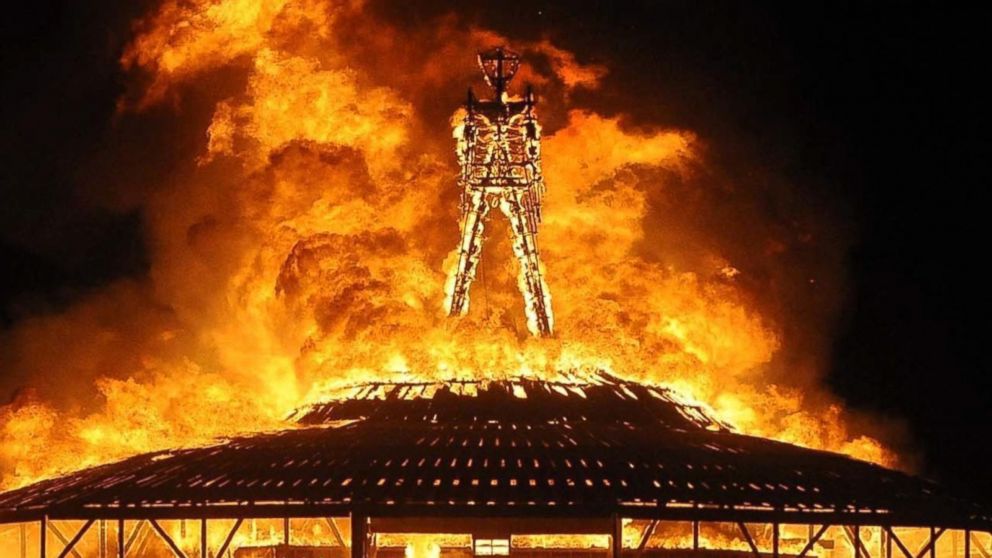
The most significant of these conceptual artworks was undoubtedly The Temple. Each year, a Temple is constructed as a locus of communal and personal release. People post photos, stories, keepsakes, mementos and messages relating to loved ones they have lost, or issues they are struggling with. The entire Temple is then burned to the ground on the last evening of the weeklong event in a solemn, silent ritual of cleansing and renewal that counters the rowdy, Saturnalian burning of the Man structure on the previous evening.

This year, the Temple architects chose to highlight western forest health problems by using lumber milled from dead salvage logs. This forest health theme is aligned nicely with the purpose and function of both the Temple, and the entire Burning Man ethos, which aims to alter attitudes of citizens in order to address systemic dysfunction in western culture.

More info about the Temple philosophy this year.


* * *

Burning Man is not the only group of artists working on forest issues, of course. Some artists are actively trying to change social policy.

Saving The West (STW) is a UC Santa Cruz-based, artist-led group working to create a new kind of timber industry that can use the small, torchy material that needs to come off of dry western forests in order to restore ecological function and resiliency. Without industry, there is no way to pay for the work that everyone, including loggers and environmentalists, now knows needs to be done. Meanwhile, our precious forests will continue to die off and/or burn. The current timber industry has retracted so far, and is still so focused on large trees--and lucrative salvage logging of the standing dead--that it is not useful at all in addressing this problem. Unfortunately, it's good business to let the forests continue to die.

STW recently received a grant from the US Forest Service to start a bi-state Wood Utilization Team working in California and Nevada in the Central Sierra Nevada Mountains.

Saving the West: A Whole Systems Proposal in Brief from Helen and Newton Harrison on Vimeo.


Tuesday, August 15, 2017

First Poet in Residence at CCI


"The Cambridge Conservation Initiative (CCI) is a unique collaboration between the University of Cambridge and leading internationally-focused biodiversity conservation organisations clustered in and around Cambridge, UK.  
CCI seeks to transform the global understanding and conservation of biodiversity and the natural capital it represents and, through this, secure a sustainable future for all life on Earth. The CCI partners together combine and integrate research, education, policy and practice to create innovative solutions for society and to foster conservation learning and leadership."

Matt Howard from RSPB on sabbatical at CCI as our first Poet in Residence.

Matt works in Fundraising for the RSPB Eastern England team. He will be spending his month of sabbatical time at CCI as our first poet in residence, starting on Monday 14 August.

Part of Matt’s role with RSPB is to explore engagement with the arts and he is the lead on the RSPB / The Rialto Nature and Place poetry competition which now additionally partners with CCI and BirdLife.

Matt’s poetry has been published in leading international magazines and journals such as The Poetry Review, New Statesman and The Dark Horse. His debut pamphlet, The Organ Box, was published in 2014.

Throughout his sabbatical, Matt will be based in the Artist in Residence studio (floor 2M of the East Tower). He will break his time up into one week a month, and he will also be at CCI some Fridays over the next few months.

In addition to providing Matt with time to write and network at CCI, the residency has a number of ambitions, all with the aim to gain a deeper understanding of how creative writing can help provide public engagement opportunities and deliver conservation objectives. Matt will be working to:
  • Host poetry events at CCI with leading poets
  • Develop the Nature and Place competition to increase its fundraising potential
  • Work with Modern Poetry in Translation magazine on an issue of international environmental poetry
  • Facilitate opportunities for other early career poets to engage with CCI to produce new work for publication and performance.
Matt will also offer colleagues from CCI member organisations opportunities to engage with the residency. Opportunities include:
  • One to ones with people interested in developing their own writing and reading
  • Establish a workshop group for those interested in writing new poems
  • Joining a mailing list to receive a fortnightly poem from the existing canon on a nature / conservation theme, with an explanatory note by him.
Matt is contactable on matt.howard@rspb.org.uk, please do get in touch if you are interested in getting involved. Information on the intranet can be found here.

Tuesday, June 27, 2017

Science Needs Story

A recent article in Medium has some good advice:
"Scientists need to tell their stories — stories about why they became scientists and what science has done and is doing for humanity. Remember, science is an abstract, intellectual process for most people. It is very hard for people to gain an emotional connection to science. That’s what narrative is for."
"Top GOP messaging strategist Frank Luntz gave this advice in his infamous 2002 memo to conservatives and team Bush about how to pretend you care about the climate while opposing serious action: 'A compelling story, even if factually inaccurate, can be more emotionally compelling than a dry recitation of the truth.' ...scientists have been trained to depersonalize their speeches, to speak literally, not figuratively. As a result, it has been easy for the Luntz-Trump crowd to create stories in which scientists are the villains."
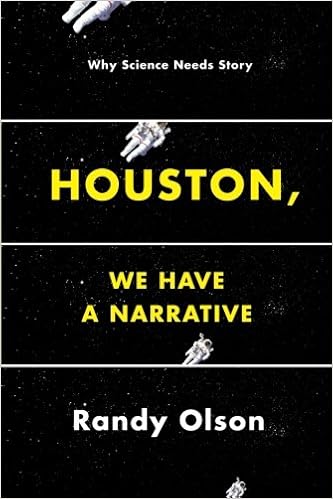
The article recommends this book for advice on crafting stories: Houston, We Have A Narrative: Why Science Needs Story, by marine biologist turned filmmaker, Randy Olson:
"Olson first diagnoses the problem: When scientists tell us about their work, they pile one moment and one detail atop another moment and another detail—a stultifying procession of “and, and, and.” What we need instead is an understanding of the basic elements of story, the narrative structures that our brains are all but hardwired to look for—which Olson boils down, brilliantly, to “And, But, Therefore,” or ABT. At a stroke, the ABT approach introduces momentum (“And”), conflict (“But”), and resolution (“Therefore”)—the fundamental building blocks of story."


Thursday, June 1, 2017

Mechanisms of discovery

Discovery is the creation of new knowledge. Both art and science are ways of combining previously unrelated elements to create this new knowledge.
"In designing this project, I have been looking for the right proportions and contrasts that set associations in motion, that invite the sort of very human experience of engaging through curiosity and being rewarded with discoveries...I think it’s an important skill to be able to read things in multiple and often contradictory ways." -- Todd Gilens
But what are the mechanisms involved in this discovery process? The philosopher David Hume argued convincingly that the human mind does not invent: it combines previously unrelated elements to create something new:
"What never was seen, nor heard of, may yet be conceived; nor is anything beyond the power of thought, except what implies an absolute contradiction...But though our thought seems to possess this unbounded liberty, we shall find upon a nearer examination, that it is really confined within very narrow limits, and that all this creative power of the mind amounts to no more than the faculty of compounding, transposing, augmenting or diminishing the materials afforded us by the senses and experience. When we think of a golden mountain, we only join two consistent ideas, gold, and mountain, with which we were formerly acquainted." 
"If all we had to go on were impressions and ideas, we could not do much more than have perceptions and notice past experiences. Hume, however, develops a powerful account of the mind by identifying the ways in which ideas may be related to one another. We can mentally link ideas together in three ways:
  1. Resemblance: A and B share similar features;
  2. Contiguity: A and B occur together in space and/or time;
  3. Cause and Effect: A brings B about.
...Hume argues that all human beliefs [and mental processes] result from applications of these simple associations. From our simple ideas and associations we build very complex systems of thought and belief. Yet, no matter how complex an idea or belief system, it is always possible in principle to analyze it into its simpler component parts: ideas and relations between them.

This theory of mind and method of analysis provided the tools that Hume used to arrive at remarkable conclusions about knowledge, understanding, metaphysics, the self, morality, justice, religious belief, and a host of other key philosophical topics." Much of Hume's work has been confirmed by later science. Read more here.
* * *

So, how does someone actually effect this productive recombination? Artists and inventors have a particular need for novelty; here are a few of the tools they have used to explore new hybrid ideas:


Surrealism is an art movement creating artworks that feature the element of surprise, unexpected juxtapositions and non sequitur. The result was achieved by by combining conscious and unconscious awareness, with the goal of effecting social change.
  • Inventor Thomas Edison also famously accessed the power of his unconscious mind by power-napping at his desk with a handful of ball bearings. When he drifted off to sleep his hand would relax, dropping the heavy metal balls to the floor. The noise woke him to record his unconscious answer to whatever question his conscious mind had been pondering.
  • Artist Salvador Dali used the same technique with a spoon and metal plate. Dali was intrigued with the images which "occur at the boundary between sleeping and waking that occur when people are falling asleep, or when they are starting to wake up. These images tend to be extremely vivid, colorful and bizarre".
  • Though it slightly predated the Surrealists, Freud's work with free association, dream analysis, and the unconscious, mirrored and inspired their goals. Despite significant errors, Freudian analysis led to a revolution in psychology, ultimately transforming it from essentially voodoo into a more scientific discipline.

Humor uses startling juxtaposition of apparently unrelated elements to convey new concepts, and to build new coping mechanisms and emotional connection to the ideas and the people expressing them:
"Humor also bestows social, psychological, and physical benefits. It attracts attention and admiration, softens criticism, delineates social boundaries, and alleviates conflict between people with different worldviews (Gervais & Wilson, 2005; Keltner, Capps, Kring, Young, & Heerey, 2001; Martin, 2007). Humor even helps people cope with anxiety, embarrassment, grief, and physical pain." (Gervais & Wilson, 2005; Keltner & Bonanno, 1997; Martin, 2007)
"...comedy goes far beyond the business of making us laugh: it has long been a powerful tool for social change and a means of undermining authority. What we find funny can also be cruel, establishing symbolic boundaries that divide people, setting those with power against those without and vice-versa." -- Artdaily.com
"Stand-up comedy is among the most popular forms of entertainment in America today. It is also one of the few places in mainstream society where people speak candidly about the topics of race and racism. This is no coincidence." -- Colleen Frances Manwell
Perhaps because of its transformative power, humor itself has often been seen as subversive: in Confucian China, in the medieval Islamic world (where comedy was dissociated from Greek drama and re-associated with Arabic poetic forms), and in more modern culture, where jokes can unite, or at the expense of national, religious or social identities can work to enforce tribalism, misogyny and racism.

However, for its transformative capacity humor is often seen as the enemy of fanaticism. In fact, "the topic of whether Christ ever laughed was hotly debated by theologians over many centuries. So, if Christ never laughed, and priests should be models of Christ, then humor and laughter were counter to true religion" (which is conservative and rejects re-interpretation).

The roots of humor include:
  • Being reflective of, or imitative of reality 
  • Surprise/misdirection
  • Contradiction/paradox
  • Ambiguity
The comedian Rowan Atkinson goes so far as to state that a person or object can become funny in one of only three ways: by being in an unusual place, by behaving in an unusual way, or by being the wrong size (Laughing Matters, 1992).

Atkinson also notes the strangely close relationship between comedy, fear, surrealism, and magic, as well as the surprising recurrence of classic themes in all of these. The physical comedian, like the ground-breaking artist, "breaks all the rules of decorum and convention".


Magic upends expectation, exploiting object behavior that obviously must be following the laws of physics, yet appears to break them. Artist and inventor John Edmark says,


Explanation of the strobe effect seen in Edmark's dynamic sculptures:


Source: Removable Thumb Magic Trick by ViralHog on Rumble

EDWARD TUFTE  ALL POSSIBLE PHOTONS
THE CONCEPTUAL AND COGNITIVE ART OF FEYNMAN DIAGRAMS


Friday, November 18, 2016

Patterns of narrative

More and more, it seems clear that human thought naturally organizes itself along patterns of narrative.

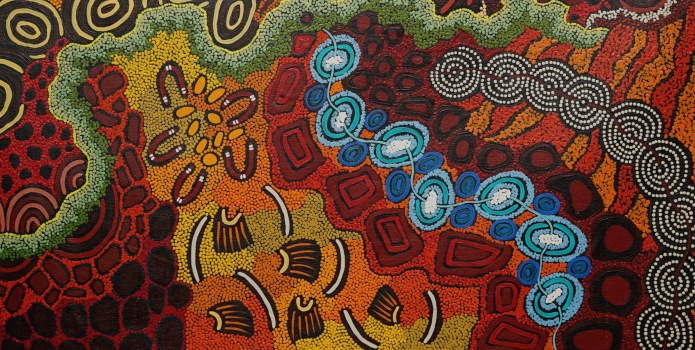
Story is how we process and understand our world, then encode that information to pass along to others. There is an argument that information passed down through aboriginal Australian songs may encode verifiable geological events from 8,000 years ago. Their visual art tradition appears to do something similar. And--at its best--what is the Judeo-Christian bible if not distilled wisdom about how to be a human from about 10,000 years ago to 100 a.d.?

Business theory accepts this idea. The "knowledge transfer cycle" states that:
"Knowledge can be stored in databases, documentation, process tables, decision trees, wikis and quick reference guides. But one of the most powerful ways to store knowledge is through stories. Much knowledge, especially tacit knowledge, exists in the minds of the experts and can be made accessible through mentoring or through connections using social media tools."
In the 1960's, Philosopher Roland Barthes worked to understand in narrative, "a principle of classification and a basis of description," pointing out that "there is a deep gulf between the most complex product of chance, and the most simple conscious construction..." He looked for the rules governing narrative construction in narrative itself: all narrative.

More recently, story narrative has been getting attention from science.
"...mathematicians at the University of Vermont have now looked at more than 1,000 texts to see if they could automatically extract their emotional arcs. And their results show something interesting, not just about narratives, but also about using this approach to study literature."
Using digitized texts from Project Gutenberg, the study found 6 consistent patterns of story. And--startlingly--these patterns hold not just in fiction but in non-fiction as well. We impose these patterns on all communication.

So what does that mean to FSMLs? Only that if we are not creating our own narrative, someone else will do it for us (and we may not be happy with the results). Understanding narrative may be a scientific process, but creating it is not: it is an artistic one.

a2ru Lays Out Aggressive Agenda for Role of Arts

"At the Alliance for the Arts in Research Universities (a2ru) conference this month in Denver, representatives from over 30 member universities talked about the need to reinvent the college curriculum, and retrain faculty too. Our students, many said, need the new thinking skills for the new economy or they will fail to get a job. The so-called 'jobless recovery' will march on but with fewer and fewer American kids...using the arts and arts integration, teaching through the arts, has the most potential to change the basic curriculum. 
Taken together, these techniques will engage students; enhance their memory and retention. Importantly, it will give them the skills they need to compete in an economy that values not just knowledge but creativity that leads to innovation. 
Yes, there are other ways to generate creativity but as Laurie Baefsky, an extremely talented executive with skills in the arts, education and conference management, and Executive Director of a2ru put it: 'arts integration is the bullet train' to acquiring creativity..."
Read complete article at Huff Post.

Thursday, November 17, 2016

Art needs science

The value to science and scientists of connecting to art is something we have explored extensively in this blog, i.e. this post. In making this connection at field research sites and marine labs, society benefits hugely from the increased discovery and outreach potential that artists can bring.

But society also benefits by increasing the environmental literacy of artists. The art/sci disconnect comes from both sides (see this discussion). Art builds culture, and in the absence of ecological understanding, aesthetics can make disastrous messes:
"We have come a long way in our understanding of introduced species in the century since publication of the Journal of Ecology began. One hundred years ago, introductions were widely celebrated, and acclimatization societies were busy ‘enriching’ the flora and fauna in many regions world-wide. Some of the more notable achievements of acclimatization societies include introducing starlings and house sparrows to the United States (in an attempt to introduce all the birds mentioned in Shakespeare’s works to New York’s Central Park; Marzluff et al. 2008)...and distributing ornamental plant species such as Lantana camara and Miconia calvescens to gardens world-wide (Meyer 1996CRC Weed Management 2003)." -- Moles, et al

Friday, October 28, 2016

ArtScience Labs

"Le Laboratoire Cambridge is an interdisciplinary culture lab that invites visitors to explore the experiments and wonders of innovative artists, designers, chefs, and more discovering at the frontiers of science. 
Founded in Paris in 2007 by inventor, material scientist, and Harvard Professor David Edwards, Le Laboratoire now lives in Cambridge as the flagship of ArtScience Labs, a global organization dedicated to radical idea development."
* * *

Le Laboratoire is part of a larger effort at art/sci convergence for cultural change called, Artscience Labs.
"Culture labs conduct or invite experiments in art and design to explore contemporary questions that seem hard or even impossible to address in more conventional science and engineering labs."
"Many of the questions that we face today — questions of innovation, of change — are not really questions we can deal with in a classical science lab."


"Labs are places of experience. We enter to explore. Each minute in a functioning lab is like a page of a smart novel that loses meaning without reference to what came before and is about to follow. 
Art, like science, is such an experience, and, yet, we encounter art and science in our museums more frequently as outcome, as product – dug up, carved down, highly edited – that follows a mysterious process of creative thought and engagement... 
At The Laboratory, we look for novel ideas of art and design that cannot be properly formulated without a sustained encounter with a pioneering edge of science. We then help broker encounters between artists and scientists that permit concrete idea formulation. Once ideas are formulated, we invest in development of the experimental projects that result. In this way, artscience, the process of creative thought that synthesizes esthetic and analytical methods, becomes a catalyst for innovation and the basis for partnership."
ArtScience Labs includes an educational program called the ArtScience Prize, a global "catalyst for student learning through passionate pursuit of innovative art and design ideas at the cutting edge of science...the ArtScience Prize [is] an interdisciplinary education program that supports young people as they explore and develop groundbreaking ideas around an annual scientific theme, seek[ing] to prepare the next generation of innovators."

2013-14 Boston ArtScience Prize from ArtScience Prize on Vimeo.


The winners of all the ArtScience Prize programs are invited to the annual ArtScience Labs Annual Innovation Workshop, which is like a Silicon Valley development incubator.

2015 ArtScience Innovation Workshop from ArtScience Prize on Vimeo.

More videos from ArtScience Labs on Vimeo and Youtube 1 | 2.
Books on ArtScience by David Edwards:


Friday, October 21, 2016

Social Sculpture and Climate Change

Like politics, science supports a position. They both have an opinion, though arising out of very different sources.

Politics is a reflection and harnessing of public opinion: the aggregate of individual attitudes or beliefs held by a population for whatever reason. Scientific opinion, on the other hand, "harnesses the opinions of many different scientific organizations and entities and individual scientists in the relevant field, and is ultimately based on observation": that is, what is empirically demonstrable. The thing to note here, is that--unlike political consensus--once scientific consensus is reached and knowledge has been created from data, that doesn't mean there has actually been any connection made to public opinion, nor to the mechanisms of social change. Art can fill this disconnect, and has frequently been used by politicians as a tool to effect change in the working of the world.

As an example,  Soviet communist party leaders "depicted the United States as a cultural black hole and cited their own significant culture as evidence that they were the inheritors of the European Enlightenment". The Congress for Cultural Freedoms was organized, operated and funded by the CIA to promote American Abstract Expressionism to Europeans in the 1950's as a superior counterpoint to Soviet agitprop art. This covert operation was enthusiastically supported by New York's MOMA and the Ford Foundation. The CIA, acting secretly due to public and Congressional hostility to modern art, funded numerous traveling European exhibitions, symphonies, and many magazines that provided a platform for favorable art criticism. The aftermath of WWII was a not just a military Cold War, but also a cultural one, fought for the hearts and minds of the European intelligentsia. The fascinating and unsettling full story of the CIA and modern art is told in at least two books and a documentary, Hidden Hands (watch Episode 2 here), by Frances Stonor Saunders. Read Chapter 1 of The Cultural Cold War here.

In fact, the CIA still maintains a collection of important modern art used for agent training.
"We’ll have some of our guys and gals come down here and do a critical analysis of the paintings. Say you’ve got to analyze this big, heavy duty ISIL problem over here — maybe if you come look at the painting, it’ll help you think about how to solve the ISIL problem creatively."
* * *

With climate change emerging as the primary global social problem of the Anthropocene geological era, and a massive obsession of the scientific world, it is startling and alarming that politics is not bending art to address this unprecedented challenge. As Bill McKibbon said, "...though we know about it, we don’t know about it. It hasn’t registered in our gut; it isn’t part of our culture. Where are the books? The poems? The plays? The goddamn operas?" Science can't offer this.

In the absence of political support (and funding), artists often seek to make cultural change on their own.
"There are experts in little things, but there are no experts in big things. All of us, no matter what we do, have the right to make moral decisions about the world....Everyone must be involved. -- Rachel Schragis 
The historian says [of war], "It's not my business." The lawyer says, "It's not my business." The businessman says, "It's not my business." And the artist says, "It's not my business." Then whose business is it? Does that mean you are going to leave the business of the most important issues in the world to the people who run the country? How stupid can we be? Haven't we had enough experience historically with leaving the important decisions to the people in the White House, Congress, the Supreme Court, and those who dominate the economy?...It is the job of the artist to...think outside the boundaries of permissible thought and dare to say things that no one else will say. " -- Howard Zinn
Art was supposed to change things … after studying art history, you realize that’s not always the case, but I love that spirit about what art is supposed to be. Art is part of our larger world so it’s not just by itself trying to do that … yeah, so art does change things.” -- Kellie Jones, Curator and Art Historian
Operating, as we do, on the front-lines of climate change, field stations and marine labs do well to engage with and support artists who are interested in the same things we are.


Tuesday, September 20, 2016

The Time of the Force Majeure...

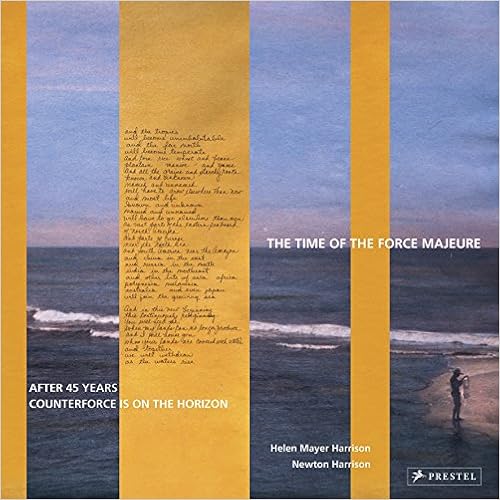
The Time of the Force Majeure: After 45 Years, Counterforce is on the Horizon
This book offers a 21st-century manifesto from the pioneers of the eco-art movement. Since the 1970s Helen and Newton Harrison have been creating art inspired by the earth. They established a worldwide network among biologists, ecologists, architects, urban planners, politicians, and other artists to initiate collaborative dialogues about ideas and solutions which support biodiversity and community development. This definitive survey traces an influential joint career that has lasted nearly half a century. Organized chronologically, it features works from each decade, from their earliest installations to their continent-traversing work of the 1990s; and their most recent works both educating people about global warming and designing large scale responses to the phenomena itself.
Helen and Newton Harrison's work demonstrates the surprising power of art to change society and influence or even create environmental policy. The scope and impact of their work is astonishing and transcends typical art boundaries. For example:
  • 1974- Crab Farm. First people in the world to discover how to get a mangrove crab to reproduce and survive in captivity. As a result first artists ever awarded a Sea Grant by Scripps institute. 
  • 1981- Baltimore Promenade. Citywide redesign centered on rebuilding the decaying promenade system in downtown Baltimore creating the cultural corridor. $15 million dollar work was incorporated into the city plan. 
  • 1989- Sava River. Long-term environmental recovery plan for Sava River, the largest tributary of the Danube. Adopted by Croation Water Department prior to breakup of Yugoslavia. Plan survived the Civil Wars and was expanded to neighboring Drava River system. Awarded Nagoya Biennale prize. 
  • 1994-2001 Greenheart Vision. Worked with a team of planners in Holland to save the 800 sq km “Greenheart” of Holland from a $220B destructive development plan. Transformed regional development. Awarded Groenveld prize. 
  • 2005-2007 Greenhouse Britain. 3-year collaboration with the Department for Environment, Food & Rural Affairs to increase climate awareness in England. Large-scale community work successful at democratizing the planning process. Awarded CIWEM prize.

Tuesday, May 31, 2016

Mary Beth Leigh | TEDxFairbanks

Seeing the Elephant: Reintegrating Arts, Humanities & Sciences
"Collaborations between the arts, humanities and sciences can strengthen our connection to the ecosystems in which we live. This TEDx talk highlights work done by Mary Beth Leigh combining ecology, dance, visual art, and other media to advance the arts, sciences, and public understanding of social-ecological issues. 
Mary Beth Leigh is an Associate Professor of Microbiology at the University of Alaska Fairbanks and is an organizer of state and national efforts to integrate the arts and humanities with ecological science. She directs the Alaska-based program, In a Time of Change, and co-organizes the nationwide networks, Ecological Reflections and ArtSciConverge. 
This talk was given at a TEDx event using the TED conference format but independently organized by a local community. Learn more at http://ted.com/tedx"

Thursday, March 10, 2016

Discovery before science

Science was invented by Al-Haytham in the 10th-century, and expanded by other Muslim scholars and Renaissance philosophers through the 14th-century. Since then, science has proven to be perhaps the most productive intellectual tool in human history.

6 simple machines are used to control mechanical
advantage. Complex machines (like a drill press) use
more than one simple machine. All were invented or
discovered before the invention of science.
Yet prior to the 10th-century, people managed to discover and invent all manner of useful things, including many technologies we typically think of as abstract, technical or scientific. These inventions include alphabets, writing, literature, philosophy, mathematics, calculating aids, and controlled chemical reactions like fermentation, metallurgy, gunpowder, and cement (whose lost formula--incidentally--far surpasses the quality we can produce today).

Pre-scientific people invented complex architecture, including massive stonework, and the arch, vault and dome; they developed agriculture and animal husbandry, including selective breeding, the seed that became the field of genetics; they invented cities, plumbing, long-distance water delivery, and sophisticated forms of government, paper money, and banking. Pre-scientific people discovered mechanical advantage, and harnessed the energy of moving water and wind to power mills and sailing vessels.

Clearly, science's incredible later success is clouding our perception of its true nature: science is not the foundational source of human creativity, discovery, invention, and problem solving. In fact, science is just a criterion of truth--a powerful way to test assumptions and hunches, and bend them to useful application. No scientist comes up with their research focus via the scientific method: you come to science with a question that needs answering.

One problem with our current tendency to off-load all of our problem-solving onto science is that very few of us are actually scientists. 1999 Bureau of Labor statistics show that only 3.5% of the total US population worked as a scientist or engineer. Those numbers are likely not much different today. So, in turning exclusively to science for answers, we are ignoring the discovery potential of 96.5% of our human population.

Science's necessary objectivity is also off-putting. People are emotional creatures, yet emotion can have no part of scientific results...or it isn't science. We are now seeing the dangerous results of alienating the bulk of our population: science has become politicized and unpopular, eroding funding and support.

So, where else can we look for creativity, invention and human investment?

The Arts are a tool of discovery, and there is a long tradition of art detecting patterns that inform later science. In the 19th-century, a largely self-taught schoolmaster turned his attention from the Humanities to mathematics. George Boole was a big fan of Aristotle, and had the insight that he could use math to extend and formalize the rules of Aristotelian Logic. In doing so, he invented an obscure new branch of mathematics.

Even other mathematicians never imagined that Boolean Algebra would ever have any practical application to science or engineering. However, decades later in the 1930's, a young mathematics student named Claude Shannon enrolled in a philosophy course at the University of Michigan. There, Shannon realized that Aristotelian Logic, in the form of Boolean Algebra, could be used to describe digital circuits. This insight formed the basis of what has come to be known as "the most important Master's thesis of the century". Shannon's work went on to create the field of Information Theory, which profoundly influenced such diverse intellectual disciplines as biology, ecology, physics, electrical engineering, linguistics, philosophy and more. Information Theory utterly transformed society, resulting in the modern telecommunications and computer industries.

So, the foundation underlying the structure of the modern world came from the Humanities. Maybe that alone is reason enough to re-engage arts with science at FSMLs?

Here is an example of an artist using a visualization technique for the beauty and provocativeness of it...

Ground Cloud from Dennis Hlynsky on Vimeo.

...and a scientist using the same technique to make a fundamental discovery:

Hummingbird research at Sagehen from F. Felix on Vimeo.