Showing posts with label artwork. Show all posts

Monday, October 8, 2018

Powerful artists

Here are some artists currently doing remarkable work at the intersection of art, environment and science. Thanks to Josh Harrison for the suggestions:

David Haley

"Ecological artist, David Haley, believes our ability to survive Climate Change is the enactment of a complex evolutionary narrative. As the dance of creation and destruction, also, demands new opportunities and meanings for the other side of collapse, his inquiries into the nature of water, whole systems ecology, complexity, and integral critical futures thinking inform his arts practice, academic research, education and community developments."

Tim Collins & Reiko Goto

"Tim Collins is an artist, author and planner, working across art, science and philosophy for over twenty years. He has worked within a wide range of communities developing research, methods and practices that take best advantage of art and aesthetics in the public interest...Over the last decade, Collins and his partner Reiko Goto have been developing artwork, tools and technologies that attend to the silent, the invisible and the different temporal relationships that occur at the scale of forests and gardens."
Jonathan Baxter

"Jonathan Baxter is an ‘artist and …’ He works across disciplines – both art and non-art related – using psychoanalytic methodologies and performative practices to variously open up, challenge and propose what is."


Lucas Ihlein 

"Ihlein is an award-winning Australian artist whose work explores the relationship between socially engaged art, agriculture and environmental management."


=================

Recommendations for artists who are compatible with field station science

Take a look at these artist's websites to see if their work resonates with yours:

"...I promised to send along the list of artists I know of who would be a great fit for a residency at a field station (and/or they may have already done something like this in the past)

Carolina Aragon

Cathleen Faubert
Helen Glazer
Ryan Griffis
Sarah Kanouse
Brian Knep
Mikhail Mansion
Jane Marsching
Lize Mogel
Teri Rueb
Brooke Singer
Joseph Smolinski
Andi Sutton

These are some that are at the top of mind at the moment, but I could certainly come up with more if folks are interested.

Best wishes,

Catherine D'Ignazio

Assistant Professor, Emerson College
Senior Fellow, Emerson Engagement Lab
Research Affiliate, MIT Center for Civic Media
@kanarinka | www.kanarinka.com | 617-501-2441"

Friday, April 6, 2018

Ohio River water quality/art project

As an artist I entered the project with the hopes of being inspired by something that would lead to a visual expression. I wanted my "research" to be creative and I allowed it to unfold as a series of related but diverse information gathering excursions.

Electrofishing with Chris [Lorentz, Professor of Biology, Thomas More College] gave me an understanding of the amazing ecosystem of the river itself. Next I met with the Ohio River foundation and talked about the main causes of pollution in the river. In 2015 there was a 500 mile long algae bloom on the river, and this phenomena captured my creative imagination as a subject to focus my goals. I did research about the documented history of industrial pollution on the river, and at the public library found an especially amazing photograph of the Cincinnati river bank from the 19th century.

In the photo you can clearly see the sewage run off exiting buildings at the rivers edge. In this small section of the photo you can see the open sewer ditch. The photo was taken in 1848 and the next year a cholera epidemic swept the city.

In my design courses, I try to get students to become more sensitive to color and shape as tools to shape an environment. For the algal bloom project, I met with a select group of talented students and we talked about the algal bloom as an experience, something immersive and expressive, so that we might find a way to personify it visually.

First we decided on a shape quality and the beginning of a color system. These decisions were based on principles of good design married to the specific attributes of the algal bloom. Here is a first small hand painted design. In this painting, we stuck to the literal blue green color scheme and used a botanical motif. The rectangle itself is a golden rectangle and the shapes are interacting with further golden ratio divisions within the larger rectangle.

Although this initial design is very interesting to look at, it does not embody the voracious life cycle and disruptive quality of the bloom. We took the initial painting and spent a long time working with it on the computer, mirroring and multiplying the design across a larger expanse. We changed the color to be more perceptually intense, and further intensified the relationship between the botanical shapes and the internal geometry of the design. The final design is here:

We hosted the NCBDS conference on the beginning design student here at UC a couple weeks ago, and I presented the project and printed the poster at a large scale.

I would love to display it more, either virtually or physically, Do you know of any opportunities? I have a file that can be printed at various scales, and it is a really exciting/immersive visual experience.

Cheers!

Emil Robinson
emil.robinson@gmail.com

ps I can send better quality files if needed

Friday, December 22, 2017

Intersecting Perspectives

"Art and science both search for greater truths and knowledge about who we are, where we come from, where we are going, and why we are here. Focusing on the collective questions we are asking - rather than from which disciplines they are explored - can foster the cross-disciplinary culture and approach our 21st century requires."

Intersecting Perspectives is a web portal that, "features the current cultural and intellectual work of 87 international SciArt Center members."

Sunday, December 17, 2017

CODAworx

"Published 12 times a year through Flipboard, CODAmagazine showcases the best design + art projects from all over the world, highlighting exemplary collaborations between designers, artists, architects, suppliers, fabricators and other industry resources."

Many of these remarkable artworks have scientific themes or inspiration, including many from one emphasis area: Technology + Art.

UNA, for example, is a collaboration between artist Wolfgang Buttress, and astrophysicist Dr. Daniel Bayliss:


Storytelling with Digital Mapping

Ouchhh Creative New Media Agency works at the interface where meaning emerges from data and digital technologies.

In addition to the expected advertising, their work includes performance art created from 3D image tracking and mapping, and inspired by scientific and mathematical topics like light physics, geometry, neuroscience, and particle physics.

Their website includes many compelling projects, including these:


Wednesday, November 1, 2017

Art and Science Collaboration: The Key to a Sustainable Future

This AASHE.org webinar from Nov. 1, 2017 is an excellent justification for art/science collaboration. It includes presentations from Emily Bosanquet, Assistant Professor, Pacific Northwest College of Art; Elizabeth Demaray, Associate Professor of Fine Art, Head of Sculpture Concentration, Rutgers University; and Kim Landsbergen, Associate Professor of Biology and Environmental Science, Antioch College.

These three academics and practitioners each have dynamic art/sci collaborations, and a lot of interesting things to say about them. The presentation was packed with excellent quotes about why this cross-disciplinary collaboration makes so much sense.

Emily Bosanquet is an interdisciplinary scientist whose "current research interest is in supporting cross disciplinary dialogue between artistic practices and scientific methodologies within a pedagogical framework in order to address social and ecological concerns."

Demaray discussed several of her hilarious and awe-inspiring projects, including PandoraBird, which offers music to wild birds, then generates Pandora radio stations based on their measured listening preferences. Demaray also discussed her FloraBorg project, which robot-izes potted plants and automates moving them to places that better meet their needs, as judged by species-specific programming, internal and environmental sensors, and weather database connections.

Kim Landsbergen is an ecologist. She discussed a project where invasive plants were used to create a journal on invasive plants. The project was received with far more enthusiasm than any scientific paper she has ever passed around.

The video recording, presentation slides, and a compiled document of resources shared during the webinar are available on the Campus Sustainability Hub at: https://hub.aashe.org/browse/video/18115/Art-and-Science-Collaboration-The-Key-to-a-Sustainable-Future

(If you do not have an AASHE login yet, please create a free account here: https://customer2597942ba.portal.membersuite.com/profile/CreateAccount_BasicInfo.aspx)

If you are associated with a university you can use their AASHE membership. Just create your account with your institutional email address.


Friday, October 27, 2017

Helicon report on Socially Engaged Artistic Practice

 "A working definition of “socially engaged art” is artistic or creative practice that aims to improve conditions in a particular community or in the world at large"

Strangely, socially engaged art generally doesn't refer to art that addresses environmental issues from an ecological perspective. This kind of art can change policy and effect cultural change around the grand environmental challenges of the 21st century. Environmental issues are at the root of much social injustice.

Nevertheless, this recent report may offer useful insight into artistic practices that could complement and extend the science occurring at field stations and marine labs. More info about the report here:
"Mapping the Landscape of Socially Engaged Artistic Practice
Alexis Frasz & Holly Sidford
Helicon Collaborative
#artmakingchange

Thursday, October 26, 2017

Prix COAL 2017

"The COAL association is pleased to announce the names of the ten finalists of the COAL Art and Environment Prize 2017! 

The 2017 COAL Award will be awarded on 29 November 2017 by the Ministry of Culture during a ceremony organized at the Museum of Hunting and Nature [in Paris]. The event is part of a day dedicated to Art, Culture and Biodiversity organized at the Museum of Hunting and Nature by the Ministry of Culture, the Museum of Hunting and Nature, COAL, the French Center of Funds and Foundations and the French Agency for Biodiversity. 

In seven editions, the COAL Prize has become the international rendezvous for artists who are taking over the main universal issue of our time: ecology. This year again, nearly 350 artists from 66 countries representing the six continents competed as part of an international call for projects. The ten nominated artists were selected for the aesthetic qualities of their proposals, their relevance to environmental issues, their inventiveness, their ability to transmit and transform, and their social and participatory approach. Together, they demonstrate how creation, in its diversity of forms and actions, is a key force in shaping the future of our societies.

The finalist artists of the 8th edition of the COAL Prize are
  • Erich Berger and Mari Keto (Austria, Finland) - INHERITANCE - The Ritual of Measurement
  • Isabelle Daëron (France) - Topical - unsafe water 
  • Abdessamad El Montassir (Morocco) - Resistance to Nature 
  • Anne Fischer (France) - Rising from its Ashes 
  • The Valley ( France) - Pietra P. 
  • Martin The Chevallier (France) - Scheduled obsolescence 
  • The New Ministry of Agriculture (France) - New local products. Diamond Gnetton 
  • Mendel (South Africa) - Drowning World 
  • Afour Rhizome (South Korea) - This wind you are talking about takes us far from ourselves 
  • Anaïs Tondeur (France) - Carbon black
The global ecological crisis now affects all societies, territories and activities, whether through climate change, the scarcity of resources, various types of pollution or the erosion of biodiversity. A global crisis that intertwines with its economic and social consequences. But this crisis is also a cultural crisis. The dominant values ​​and representations, our globalized culture, determine our individual and collective behaviors, and ultimately our collective impacts on the planet. Also, the solutions to this crisis cannot only be political and technical. Culture can be a major player. This is what COAL has been promoting since it was founded in 2008. The COAL Award is aimed at all artists who, throughout the world, witness, imagine and experiment with solutions for the transformation of territories, lifestyles and organizations, and modes of production. Together, they are helping to build a new collective narrative, a new imaginary, common heritage under development, a positive, optimistic and necessary framework for everyone to find the means and the motivation to implement the necessary changes towards a more sustainable and just world."

See the winning artists and learn more here.

Monday, September 11, 2017

Art That Raises Awareness of Forest Ecology Issues

LaynaJoy Rivas and Eva Reiska’s “Sysimetsä”, a memorial
for those affected by the fires that destroyed Lake County, as
well as for a beloved art space by the name of
Ravens Landing back in 2015.
1. Trees (and/or forests) are iconic symbols in virtually every culture;
2. Western US forests are in crisis.

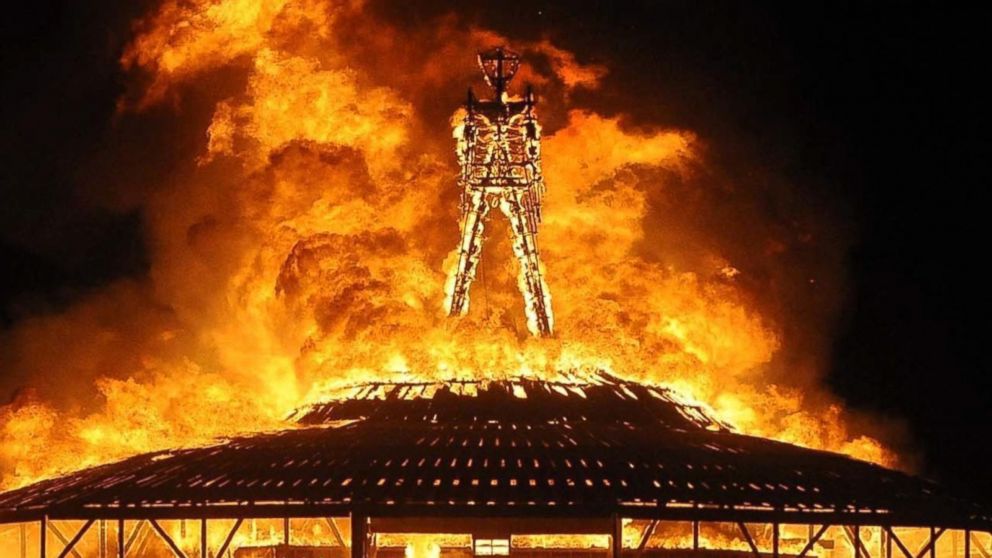
Combining or juxtaposing previously unrelated ideas is how humans create new knowledge, whether with art or science. So, how are artists combining these two ideas at Burning Man, one of the country's most controversial art events?

"Ursa Mator," by Mr. and Mrs. Ferguson: a gorgeous
sculpture covered in shimmering, edge-wise pennies takes 
on additional meaning as the Man burns in the background. 
Large wildfire destroys forest ecosystems, including 
iconic wildlife.
Black Rock City--the temporary Nevada city of 70,000 people (including an airport that is the busiest one in Nevada while it lasts!)--displayed numerous tree &/or forest issue themed artworks in 2017.

The most significant of these conceptual artworks was undoubtedly The Temple. Each year, a Temple is constructed as a locus of communal and personal release. People post photos, stories, keepsakes, mementos and messages relating to loved ones they have lost, or issues they are struggling with. The entire Temple is then burned to the ground on the last evening of the weeklong event in a solemn, silent ritual of cleansing and renewal that counters the rowdy, Saturnalian burning of the Man structure on the previous evening.

This year, the Temple architects chose to highlight western forest health problems by using lumber milled from dead salvage logs. This forest health theme is aligned nicely with the purpose and function of both the Temple, and the entire Burning Man ethos, which aims to alter attitudes of citizens in order to address systemic dysfunction in western culture.

More info about the Temple philosophy this year.


* * *

Burning Man is not the only group of artists working on forest issues, of course. Some artists are actively trying to change social policy.

Saving The West (STW) is a UC Santa Cruz-based, artist-led group working to create a new kind of timber industry that can use the small, torchy material that needs to come off of dry western forests in order to restore ecological function and resiliency. Without industry, there is no way to pay for the work that everyone, including loggers and environmentalists, now knows needs to be done. Meanwhile, our precious forests will continue to die off and/or burn. The current timber industry has retracted so far, and is still so focused on large trees--and lucrative salvage logging of the standing dead--that it is not useful at all in addressing this problem. Unfortunately, it's good business to let the forests continue to die.

STW recently received a grant from the US Forest Service to start a bi-state Wood Utilization Team working in California and Nevada in the Central Sierra Nevada Mountains.

Saving the West: A Whole Systems Proposal in Brief from Helen and Newton Harrison on Vimeo.


Monday, June 19, 2017

On Sustainability and Art: artist Hannalie Coetzee

Fire-created artwork.
ART AFRICA looks at the practice of artist Hannelie Coetzee. "Hannelie Coetzee’s artwork draws attention to our warped relationship with nature through pragmatic, solution oriented interventions."

The article also includes highlights of a fascinating discussion between the artist's associates and collaborators.

Some interesting quotes from the article:
The more intuitive approach of artists can provide a window into the complex models, calculations and simulations of the scientific world… Natural world issues require more than just a technical fix. They require systems of thinking and creativity to imagine and illustrate the best possible solutions. -- Prof. Caroline Digby from the Wits Centre for Sustainability in Mining and Industry
Sustainability is not primarily a scientific problem; rather, it requires us as citizens, communities and societies to rethink the way in which we live our personal lives… This requires engaging the hearts, minds and imaginations of a wide set of people across many different spheres of society. Artists have a particularly important role to play in this regard – not only in creating a space that can help bridge and connect between different actors, but in contributing and opening our minds to completely new ways of seeing the world and our place in it. -- Dr. Reinette Biggs of the Stockholm Resilience Institute and the University of Stellenbosch
How can art and science integrate into a discipline or collaboration that aids transformative understanding?

Art is the expression of creative ideas that are likely informed by prior knowledge but not restricted by natural, economic or social rules. Science is a knowledge that we have built through methodical enquiry over many generations into how nature, economics and society work. When art is introduced into science, it gives permission to seek different ways of addressing the same problem. It enables one to leapfrog or do a U-turn. As stated in New Roles for Art Are Clarified (Carney 2010), Tim Collins declares that, “while replicable fact is the domain of science, human perception and value are the domains of art and the humanities. – Philipp Kirsch, University of Queensland

How do such partnerships reach wider audiences?

I have been astounded by how much easier it is to interest people in the science when it is encompassed in an artwork. Before, I was only talking to the small community of people who were already thinking about these issues. People like the art – and they like the idea that the art has some scientifc substance behind it. Some, not all of them, want to know more details about our science questions and I am challenged to maintain their interest and expand it. – Sally Archibald, WITS
How can partnerships between artists and scientists contribute to resilient systems and change?

The data on climate change is indisputable, but how does one develop an emotional appreciation of the potential consequences? I think this must come through experience and art is a fantastic mechanism to develop emotional experiences and consider possibilities. – Caroline Lehmann, Biogeography, University of Edinburgh

How has an artist’s work influenced your work and vice versa?

Hannelie sometimes brings aspects that I think of as ‘outside’ the system, into the discussion. At its simplest, ecology is the study of the interactions between organisms and their environment and it is refreshing to have a different take on the shape and form of these interactions. – Sally Archibald

I started to write a conference paper about the potential to re-imagine mining overburden as a building material. To change the way that the industry framed everything as waste rock, waste dumps, waste piles etc. In researching this, I uncovered the genre of Land Art. These artists have given considerable thought to moving earth to make art. I strongly believe in the potential for artists to create not just new mine closure landscapes, but to also drive improved community relations when working side-by-side with the engineers and financial managers in mine planning and operations. – Phillip Kirsch

Read complete article here.

Saturday, June 17, 2017

Field Notes of a Terranaut

Artist Alan MacDonald was inspired by the notebooks of DaVinci and Michelangelo to create his recent work, Field Notes of a Terranaut. MacDonald has some lucid ideas about the creative process:
"Our senses filter out vast amounts of information unessential for survival of the body-organism. Yet still, a trickle of information enters the mind experienced as intuition, a creative spark. Aha moments. Truly creative artists are in a sense mystics, 'receiving' non local information in order to co-create local objects that inspire and extend consciousness."
I would argue that this statement applies to truly creative scientists, as well: they notice things that the rest of us filter out. Perhaps we lack a term for the truly creative perception that distinguishes transformative art and science from the merely pedestrian?

Codex Gunnison


Codex Gunnison is an art project that explores a poorly studied natural phenomenon in the Gunnison arm of the Great Salt Lake, UT. This bay is the saltiest water body on earth, yet it still manages to host life: a peculiar, salt-loving microbe that colors the bay's water pink and creates rock-like forms on the ground.
"Codex Gunnison is a mediative engagement with a unique and understudied ecological condition. It is also an effort to reimagine artistic practice as a speculative and vibrantly humanistic material science capable of interacting with and enriching conventional modes of objective inquiry. It does so by reframing representation as a process of critical engagement with the methodological frameworks employed by scientists with the artist manipulating the scope, aims, and outcomes of formal research."
Isn't this just a perhaps overly post-structural way of describing Natural History?

If so, it's nice to get back to that effort, which combined passion and close observation to gain understanding of natural phenomena before there was a structured practice of science to do that. Natural History combined artistic and analytical thinking and skills in a powerful way that has to some extent been lost in the process of science becoming more technical and fragmented.

These Nine Artists Will Help You Understand the Future of the Planet


Smithsonian curator Joanna Marsh highlights 9 contemporary artists whose practices are conscious-raising and problem-solving. Here are some quotes from the full article:
"Part of the reason that there is a lot of public inaction around climate change and environmental issues more broadly is because the science isn't communicated in an accessible way that triggers emotional responses and curiosity on the part of the public." -- Joanna Marsh
"I frankly believe we’re at a moment where we have some really big problems and we need as many minds that can come together from as many different perspectives as possible to address these issues because we’re not going to resolve them just within one field of study." -- Krista Caballero
"One of the challenges of our time is that people feel disconnected from – perhaps even insensitive to – the world’s great problems. We do not see ourselves as agents in a global society. Climate change, poverty, war, and illness are all challenges that vie for our attention. The overwhelming avalanche of information in society today, coupled with the PR efforts aimed directly at us, as individuals, have resulted in many of us accepting that something has to be done. Yet there is a huge gap between what we know and what we feel. How can we translate knowledge into action, and really change our behavior? Of course, it is necessary to present the facts and data supporting climate change science, but this is not where action begins. Only by embodying knowledge can we gain a sense of responsibility and commitment." -- Olafur Eliasson

Wednesday, May 3, 2017

Interlochen Arts Academy land art

Brief Summary of the Project:
This new collaborative project that uses “land” as a genre to bring visiting artists, scientists, and land use planners together with high school art and ecology students.

After conducting a Forestry Management Plan, Interlochen Center for the Arts identified about 70 acres of pine plantation on our campus that need to be selectively harvested and re-forested with native hardwood trees. Ten acres of this land have been identified as a study site for ecology and visual art students to document changes in biodiversity, soil and carbon capture as a result of the timbering process. We have the opportunity to create a permanent land art installation commemorating and responding to the process.

Two classes that run simultaneously in Math/Science and Visual Arts allow students to collaborate on the project. The design of a public trail system that runs through the land-art installation provides accessible recreation to our students and the community and raises awareness about the importance of protection, regeneration, conservation and the role art has in making the process meaningful.

The impact of this collaborative project reaches beyond our students and the land on our campus to the people in our community and will hopefully be a model of how to use art to invite the public into environmentally important projects nationwide.

Project Description: Due to the generosity of WilsonArt, funds are available to both study the pine plantation before, during and after timbering, and to involve students, faculty and visiting artists in a land art installation in the subject area. Our proposed plan has the following elements:
  1. The subject area will be timbered in late 2017 / early 2018.
  2. In the school year 2017 - 18, Johnny Hunt, visual arts instructor, will offer a landscape art course, based in the Visual Arts Division, open to students of all majors. Mary Ellen Newport, Director of Math and Science / Ecology instructor, will teach an ecology class that is offered at the same time as the art course. Ecologists and artists will study ecology and landscape art separately, and then have the occasion to work together in the studio and in the field on art and science.
  3. A visiting artist will be brought in to work with instructors to plan, design, create, and ultimately install the land art project in a 10 acre area of the timbered pine off Riley Road. Elements of the plan will consider some or all of these themes:

    • Regeneration
    • Invitation / initiation / blessing of new forest
    • The replacement of the plantation with the natural
    • The way that forests and art are shaped by the passage of time
    • The creation of a special place, a grove, a sanctuary, a nursery; a space that may or may not be able to acknowledge native American sensibilities
    • The changing nature of a forest in the process of secondary succession
    • The role of (bio)diversity in creating stability

  4. Guest artists, native artists, scientists and land use planners will be brought in to deepen the experience between ecology and art. Plans for trails / paths, observation decks, planting regimes will be developed. The expectation is that some of the timbered wood from this plot could be used in building structures such as shelters for students doing data collection, bird observation decks over Bridge Lake.
  5. Here is what we have put together as a description for the artist(s) we have involved: Interlochen Arts Academy seeks collaboration with a visual artist to guide science and arts students in the creation of land art for a 10 acre pine plantation forest that will be transformed (over the years) into a native forest. There are scientific objectives to the project (document changes in soil, biodiversity and carbon storage) as well. Ideally the artist would be available to consult with students for 2 week period in the early fall 2017 (in residence), a time in late fall 2017 (by remote, if necessary) for two weeks in January 2018 (IAA's Inter*Mester program), and for a time TBD in the spring semester 2018.

Images of the land and the areas we are focusing on for this project. The zoomed in area near the lake is where the art would be installed. The pine plantation between Riley Road and Bridge Lake is the location of the project. The project location contains scrubby Scotch pine to the north and west, an irregularly shaped patch of red pine more centrally located, and a wetlands area with a path leading SW to Bridge Lake. The irregular patch is the location of the project.


Melinda Zacher Ronayne
Director of Visual Arts
Interlochen Center for the Arts

E: melinda.ronayne@interlochen.org
P: 231.276.7844
W: interlochen.org

Interlochen Arts Camp | Arts Academy | College of Creative Arts | Presents | Public Radio

Wednesday, March 1, 2017

Exhibit: SOLSTICES AND EQUINOXES

SOLSTICES AND EQUINOXES: PAINTINGS BY LEAH WILSON

January 17 – May 14, 2017
Roger W. Rogers Gallery
Willamette University
Mary Stuart Rogers Music Center
900 State Street Salem, OR 97301
Hours: Monday – Friday 8am to 6pm

Winter Solstice, Leah Wilson.
In its measured and diligent investigation of minute, incremental changes in light levels at a specific site in the H.J. Andrews Experimental Forest over time, this series of paintings represents a seamless merger of art and science as it throws into high relief the pivotal role of change in ecosystems. It also examines the nature of perception, and the idea that by studying phenomena, we change them.

The genesis of the project lies in Wilson’s experience as an artist-in-residence at H.J. Andrews, a 16,000 acre long-term research site which is located in the Western Cascades east of Springfield, Oregon. During her residency, Wilson had the opportunity to observe scientists from Oregon State University’s Department of Forestry, who are currently in the 30th year of a 100-year log decomposition study.

The study involves deliberately placing a number of tagged logs in a wide variety of locations in and around the streams that run through the forest in order to test the effect species and size of logs have on decomposition and nutrient cycling processes. Wilson’s interaction with this research led her to realize that science in general, and ecology in particular, seeks to identify patterns (and changes in patterns) over time. It is therefore fitting that both in terms of process and product, the most evident element of the work would be repetition, rhythm, and pattern.

The selection of the solstices and equinoxes of a specific year for the collection of her “data points” connects the cycles in a specific place and ecosystem with much larger and more powerful astronomical cycles. In comparing the barely perceptible, incremental chromatic changes that occur over the course of a day with the large seasonal changes that occur during the course of the earth’s orbit around the sun, Wilson’s work underlines the universality of the forces and phenomena that affect her specific, chosen site.

While the careful, and even clinical attention to methodology, process, and detail might lead us to think that Wilson’s work is purely scientific, there is much more at work here than only a concern with science. Her work is also a symbolic and meaningful examination of the philosophical idea that change is the only true constant. Wilson points out that the nature of our senses and perception influences and changes the thing we study. She also demonstrates that the very act of studying something changes it. She explains her realizations in this regard as follows,
“Not only do our senses and brains edit information, and therefore the patterns and rhythms we perceive, but we have affected every environment and ecosystem on the earth, directly or indirectly, which also affects the way that we experience the patterns of change in the environment. Looking upstream from my location on the creek, the wild ruggedness of the old growth forest is apparent. But looking downstream is an abrupt intersection of wildness and human construction, a reminder of the way we alter our environment to fit our specific needs of that place.” 
Wilson was able to observe human interventions occurring at her site during the course of her one-year process. She explains that these human interventions affected the patterns and rhythms of chromatic change in the creek, and subsequently in her paintings. She elaborates as follows:
“Even environments that appear wild and untouched are still affected by human intervention: a road can change the speed and redirect water during a storm; national parks are highly managed to control plant and animal populations; fires are suppressed or started to achieve a desired environmental effect; and climate change affects ecosystems across the globe. I chose to observe this location on the creek because of the juxtaposition of wildness and the constructed environment created to observe and understand it. The act of observation changes the patterns that we observe, whether it is though what we construct, the instruments we use to perceive, or our own physical perceptions. …..” 
Leah Wilson is a Eugene resident and practicing artist. She obtained her MFA from the San Francisco Art Institute.

  -Andries Fourie (Curator, Roger W. Rogers Gallery)

Friday, February 26, 2016

Architecture of Life exhibit

UC Berkeley has a current show that includes anatomical drawings by Ramón y Cajal that are still used in medical textbooks today. From a review by NPR:
Santiago Ramón y Cajal: Microglia in the grey
matter of the cerebral cortex, 1920.
 "We forget that it is hard to see. To paraphrase Kant (loosely), seeing without understanding is blind, even if understanding without seeing is empty. A good drawing — for example of the working parts of an engine — is often much easier to interpret than an actual perceptual encounter with the engine itself. The engine, after all, is very complicated. What is important? What deserves notice? It's hard to know. But the drawing, when it is successful, is more than a mere representation; it is, really, the exhibition of what something is, of how it works, of what it is for. A good drawing is an image that has been imbued with thought."

Architecture of Life runs through March 29, 2016 at BAMPFA, the new visual arts center of UC Berkeley.

Monday, December 7, 2015

ArtSciConverge partnership at Aquarium of the Pacific

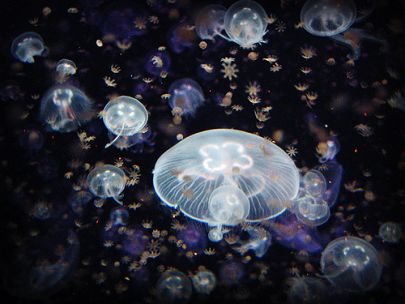
"The Aquarium of the Pacific has commissioned a project that brings art and science together to
translate the movement of sea jellies, or jellyfish, into a symphony...The Symphony of Jellies was developed based on an algorithm that tracks the movements of sea jellies and translates them into sounds...

Marty Quinn, founder of the Design Rythmics Sonification Research Lab, developed software and hardware to capture sea jellies movements with digital video footage and translate them into sounds through a process he calls MoveMusic sonification. Composer Eddie Freeman of Icarus Music used those sounds to create musical motifs and orchestration. Aquarium President and CEO Dr. Jerry Schubel and Aquarium Trustee Dennis Poulsen served as advisors and partners on the project."

Schubel and Quinn are members of the ArtSciConverge effort, and met as participants in the 2015 Reno Workshop.