Showing posts with label exhibit. Show all posts

Tuesday, June 12, 2018

The Cross-Pollination Experiment


Jeff Lockwood
In 2014, 4 artists, 4 scientists and the project coordinator, all from the University of Wyoming, met at the prestigious Ucross Foundation ranch for a 2-week retreat. The results of that collaboration—called the Cross-Pollination Experiment--are astonishing and ongoing. The following is a record of correspondence about the project between me (Faerthen Felix), participant Michael Dillon, and organizer Jeff Lockwood.

Jeffrey A. Lockwood is Professor of Natural Sciences & Humanities at the University of Wyoming. He began his career as an entomologist, then shifted to philosophy.


Michael Dillon
Michael E. Dillon is an Associate Professor in the Department of Zoology and Physiology & Program in Ecology at the University of Wyoming. Dillon also serves as Director of the University of Wyoming - National Park Service Research Station.


Brochure, explaining the project and some of its outcomes.

-----------------------------

FF: It looks like Ucross facilitated the Cross-Pollination Experiment. How did they find all of you? Was it an open call, or were you recruited? It sounds like there was an "organizer" and Ucross didn't just invite you all out to stay, then leave you alone. Who was that organizer, and how was the experiment structured? Were there structured exercises, specific goals and deliverables?

MD: Jeff [Lockwood] was the mastermind of the initial Cross-Pollination project (which led to all the other good stuff), did the fund raising (from many sources on and off campus), and was the leader. He planned all the activities, the approach, etc. Briefly, we were invited by Jeff and then all lived together for 2 weeks -- we had separate housing but spent most of our meals and lots of free time just hanging out. This was a critical element, in my opinion, because we had the chance to really get to know and trust each other. Jeff ran nightly post-dinner meetings in which we reflected on the day, discussed the positive, negative, difficult, exciting, etc.


Our first day was a "perspective" day, in which we all had the morning to prepare a presentation about the place (Ucross) through our eyes/experience/academic background. We spent the afternoon moving between our studios giving and attending these presentations (8 in all). Jeff then organized a "speed dating" for the next day in which each artist spent 1 hour with each scientist discussing ideas. The goal was to come out of each of those meetings with several concrete ideas for how you could collaborate in a meaningful way. That is, not just artists interpreting the science or scientists trying their hand at art, but rather collaborations that enhanced both disciplines. Jeff paired us up (not sure how he decided as there were so many interesting collaborations possible!) and then we went to work. We had less than a week to make progress on the collaboration as Jeff had already scheduled a "Saturday University" event for the end of the trip in which we would present our "products" to the broader public in the Ucross space. 

JL: Some backstory…I did a residency at Ucross as a writer.  And in the course of that time, I had some lovely chats with Sharon Dynak, the executive director.  She indicated that Ucross was increasingly interested in projects that would integrate natural sciences and arts, particularly as a means of gaining a deeper appreciation of the ranch and surrounding countryside.  I was putting together a pitch for a UW venture in this regard when Shannon Smith (executive director of Wyoming Humanities Council) met up with me and became super-excited about the possibilities.  So Ucross provided enormous in-kind support and WHC provided financial support (especially in terms of the public presentations as UW’s Saturday University program that summer).  I should also note that the UW Biodiversity Institute provided funding.  I’ve also attached one of the original proposals so you can see what approach was being advocated.


FF: I find that, almost universally, people who have engaged in art/sci collaborations find them useful and positive, but it is difficult to measure outcomes clinically, and there is little actual science available on the results. Do you have any publication references that somehow document the effectiveness of the collaboration?

MD: I know what you mean, but don't have references. Our own experiences and all the products that have emerged are the best evidence I can provide.
"This has been an incredibly productive, fruitful venture: 3 exhibitions, a documentary film, an online repository of microbe portraits and artist responses to them, an opera, and Xbox Kinect video game, 3 NSF grants to date totaling over $6 million in funding. The cross pollination website has links to videos and other information about the different projects. We continue to actively develop new projects and collaborations. This venture has been one of the most exciting, invigorating, rewarding, and fun things I've done for quite some time!" -- MD
JL: I’m there with Michael.  Our products speak for the productivity of this venture.  But one of the deliverables is also a sense of morale, excitement, playfulness and fulfillment for academic artists and scientists who may not see much “external” reward and, indeed, have good reason for demoralization.

FF: I found this statement by Jeff Lockwood really interesting: "These synergies have revealed elements of the natural world that would otherwise be overlooked by both artists and scientists." Can you elaborate and provide some examples? This is a big aspect of our push to get more art at field stations: that art is a discovery process that can enhance scientific creativity, and uncover raw material for science. But finding clear and obvious A-to-B examples is challenging.

MD: One example was my collaboration with Rachael Shaw, a dancer/choreographer. We used the notation of dance (Laban notation) to quantify the posture and movements of bees after exposure to sublethal doses of pesticides. A tool from choreography allowed us to better quantify something that was otherwise difficult to describe but visually obvious: bees move differently when exposed to minute quantities of pesticides. Unfortunately, we have not published this work. Rachael moved not long after the initial Ucross trip and we've found it difficult to find time to work together from a distance. Other examples are the microbestiary, and a collaboration between Jeff and Anne Guzzo (a composer): an opera about the disappearance of the Rocky Mountain Locust.

JL: Yup, LOCUST: THE OPERA is premiering this September (I’ve attached the proposal for that project so you can get a sense of the science/art collaboration)—and I should add that Ashley Carlisle, one of the Ucross participants, will be designing and producing our costumes, scenery, etc.


FF: It's great that UWYO faculty work with Ucross. I think field research stations would really benefit from identifying artist-residencies near them to collaborate with on art/sci linkages.

MD: Ucross was fantastic - very supportive of the whole endeavor. But, although some of our art faculty apply for and are awarded residencies at Ucross, I am not sure that the Art/Science residency is an ongoing element for them.

JL: I think that one of the key features that made our venture successful (in addition to my very carefully selecting participants—there was no open call for people) is that everyone came from one institution, which has allowed the venture to continue for years with all sorts of combinations and recombinations of people based on interests and opportunities.  And such ongoing collaborations would be very difficult to sustain across institutions (heck, they’re hard enough across departments and colleges in a single institution!).

FF: Is there any kind of exportable prescription that either guided the process, or emerged from it? Something like the HJ Andrews Ecological Reflections program that is kind of plug-and-play for any field station that wants to participate, or Best Practices, or anything like that I can direct field stations to? 

MD: I think that, in our case, the key was Jeff's vision -- the combination of prescribed reflection and conversation time, of a deadline for a product, and also of flexibility so the group could go where it wanted to (we often veered from Jeff's original plan - to his consternation and delight, I think). 


JL: If there is anything approximating a set of guidelines/rules, it might be found in this very concise summary on YouTube. I’ve attached the text that I used for this Ignite presentation:

IGNITE
Science & Art: Instructions for Making a Chimera

1.
I have had the joy of orchestrating a three-year project bringing art and science into collaboration. We call ourselves the Ucross Pollinators to honor the institution hosting our gatherings—and to capture the underlying spirit.

2.
The Wyoming Humanities Council has been our principle supporter because they understand that if the arts are the flowers of civilization and the sciences are its stems, then the humanities are the roots.

3.
Our products include: National Science Foundation grants infused with art, a Microbestiary of unicellular life, a choreographic scoring method to encode insect movement, and operatic arias evoking the geology of Wyoming.

4.
I’d like to share with you what I’ve learned as an academic anthropologist, observing artists and scientists working and creating together—as well some thoughts about the institutional framework in which they are embedded.

5.
As for the people, here’s a simple but important consideration.  Scientists are not artists and vice-versa. Each pursues distinct ways of knowing themselves and the world.  To which I say, Viva la difference!

6.
The recipe for a tasty collaboration of artists and scientists is not to blend them into a homogenous smoothie, nor to make a loosely tossed salad.  Instead, simmer them together into a mouthwatering stew.

7.
For our venture, I chose “big dogs”—people at the top of their game, not those needing to yap to establish their dominance in the pack.  I’ve found that little dogs are much more likely to bite.

8.
The sense of wonder among the participants that catalyzed collaboration was akin to watching a spellbinding magician—and then being even more enchanted upon learning how the scientific or artistic trick was done.  

9.
The one quality that is critical to fruitful art-and-science ventures is playfulness—a vulnerable, childlike willingness to ask “why not?”, to wonder “what if?”, and to genuinely share one’s toys.

10.
Scientists and artists need more than a one-night stand to achieve satisfaction.  Fulfillment requires sustained interaction, and fertility is enhanced by proximity.  And so, being colleagues at the same institution is a tremendous asset.

11.
Collaboration does not mean artists making science pretty.  Rather, it requires mutual respect and that means genuine parity of power and prestige.  In this dance, each must be willing to lead—and to follow.

12.
Without constraints, the possibilities at the intersection of science and art are astronomical.  We need boundaries. Or as Robert Frost said of free verse poetry: It’s like playing tennis with the net down.

13.
An interdisciplinary team is often seen as having an ecologist and geologist.  Nobody ever adds a poet or dancer. We sought transdisciplinarity—engagement that was synergistic rather than additive.

14.
I’ve observed that pairs work extremely well.  Having one partner allows intimacy. Academic orgies don’t entail the commitment that sustains relationships.  Maybe science and art collaborations are like American marriage—serial monogamy.

15.
Turning to the institutional context, universities might tolerate, but rarely encourage, science-art collaborations—unless there’s money to be had. So, individuals must find working together to be internally rewarding.

16.
Trying to define science and art is an unhelpful starting point institutionally—much like attempting to define the humanities.  It’s like saying that before dating, one must define beauty, intelligence, and love.

17.
The university has islands of authentic collaboration—such as the Art Museum and the Biodiversity Institute—floating in a sea of institutional ambivalence.  For the most part, we have a College of Arts or Sciences.  

18.
STEM (Science, Technology, Engineering and Math) is a glutton.  Adding the Arts to create STEAM (I prefer MEATS) still leaves artists nibbling crumbs from the table.  But please sir, I want some more.

19.
Art-and-science collaborations subvert institutional norms.  The results don’t add up on a spreadsheet; they defy administrative classification.  These projects are viewed as the icing, not the cake, of a respectable academic career.

20.
In conclusion, art-and-science collaborations are acts of humanistic faith.  The Cross-Pollinators will continue to pursue beautiful, grotesque, and strangely enchanting works that take flight—or not.


Cross-Pollination Experiment documentary. Explains the program in detail as it unfolded.


Saturday University lecture. Explains some of the trouble communicating the project.

More videos.

Thursday, December 21, 2017

Natural Discourse: Artists, Architects, Scientists & Poets in the Garden

Jenny Kendler
Bewilder (Deimatic Eyespot Camouflage) 2016-2017
Living Proof: Flora, Fauna & Fossil Fuels
Space 151, San Francisco
Opening January 13, 2018. 5-8pm

"Jenny Kendler has printed wallpaper and fabric composed of thousands of collaged photographs of butterfly and moth eyespots. These bullseyes of color and form are thought to protect winged insects by frightening or confusing predators. In the Bewilder project, this deimatic camouflage becomes something new. Visitors are given eyespot temporary tattoos and invited to pose for a portrait in front of the brilliantly colored pattern. These colored marks confuse the digital gaze — just as butterflies' spots confuse predators — and disrupt facial-recognition software, creating a new type of camouflage for the modern, digital world of privacy loss and online tracking."
Natural Discourse: Artists, Architects, Scientists & Poets in the Garden’ is an ongoing series of symposia, publications and site-specific art installations that explore the connections between art, architecture and science within the framework of botanical gardens and natural history museums.

Natural Discourse began as a collaborative project between the University of California Botanical Garden at Berkeley (UCBG) and a multi-disciplinary group of artists, writers, architects and researchers who were invited to spend time in UCBG’s extraordinary collection of plants, engage with the horticulturalists and develop new site-specific work. 
 
The resulting exhibit was on view in the garden’s collection from July 2012 to January 2013. From 2012 to 2017 six day long Natural Discourse symposia combining artists and scientists have been held at UCBG, the LA County Arboretum and Botanical Gardens, The LA County Natural History Museum, the La Brea Tar Pits and Museum and the Huntington Library, Art Collections and Botanical Gardens. In 2016, the exhibit Digital Nature: An evening of Techno-Botanical Art in the Garden was held for two nights at the LA County Arboretum.

Sunday, December 17, 2017

Storytelling with Digital Mapping

Ouchhh Creative New Media Agency works at the interface where meaning emerges from data and digital technologies.

In addition to the expected advertising, their work includes performance art created from 3D image tracking and mapping, and inspired by scientific and mathematical topics like light physics, geometry, neuroscience, and particle physics.

Their website includes many compelling projects, including these:


Sunday, October 29, 2017

In a Time of Change (ITOC)

The In a Time of Change (ITOC) program is a strong and well-developed model for art/sci collaborations at field stations, marine labs and artist residencies.

ITOC is a large effort that links a cohort of artists with dozens of scientists for over a year; but the model is scalable to smaller programs, shorter time periods and modest exhibitions. ITOC provides a potential partnership opportunity with museums and galleries near your field station, and could be structured as a university semester program linking art and science grad students. Or the program could provide a Broader Impacts opportunity to NSF-funded researchers at your site.

[ITOC] was founded in 2008 by artists and scientists in Fairbanks with support from University of Alaska - Fairbanks and the Bonanza Creek Long Term Ecological Research program.
ITOC recognizes that the arts, humanities, and sciences bring different, yet synergistic perspectives and reactions to the natural world. Collaborations between the arts, humanities and sciences engage people at the intellectual, intuitive, and emotional levels, and strengthen their appreciation for the environments and ecosystems in which they live. Combining these diverse perspectives also yields greater success in solving complex environmental problems and promoting outreach and education than science alone. 
ITOC was co-founded and is directed by Mary Beth Leigh, an Associate Professor in the Department of Biology and Wildlife and the Institute of Arctic Biology at the University of Alaska Fairbanks. Leigh is an environmental microbiologist with a background in the fine arts as a dancer, choreographer, and musician. She has a strong interest in fostering collaborative arts-humanities-science activities.
The ITOC programs connect a cohort of artists with numerous scientists over many months. The artists learn about the current project theme in the lab, the classroom and the field: on the UAF campus, the Bonanza Creek Experimental Forest and the Toolik Field Station. Artists in the program then develop works inspired by the theme.

Artistic media have included painting, sculpture, tile, printmaking, textiles, artist books, writing and multimedia, The project artworks are presented through gallery exhibits, websites, public readings, and other events. ITOC works have been included in exhibits at the National Science Foundation headquarters in Arlington, VA.

Past ITOC programs were themed on Microbial Worlds (2017),  Trophic Cascades (2013), The Art of Fire (2012), Envisioning the Future (2010), In a Time of Change (2008).

Another model that can be quickly adopted by additional field stations is the Ecological Reflections program at the HJ Andrews Experimental Forest.

Thursday, June 1, 2017

Emily Dickinson’s Herbarium: A Forgotten Treasure at the Intersection of Science and Poetry

 "In an era when the scientific establishment barred and bolted its gates to women, botany allowed Victorian women to enter science through the permissible backdoor of art, most famously in Beatrix Potter’s scientific drawings of mushrooms and Margaret Gatty’s stunning illustrated classification of seaweed. Across the Atlantic, this art-science adventure in botany found an improbable yet impassioned practitioner in one of humanity’s most beloved and influential poets: Emily Dickinson (December 10, 1830–May 15, 1886). 
Long before she began writing poems, Dickinson undertook a rather different yet unexpectedly parallel art of contemplation and composition — the gathering, growing, classification, and pressing of flowers, which she saw as manifestations of the Muse not that dissimilar to poems."


Read entire article here.

Monday, May 8, 2017

"Dan Goods, JPL's science seer"

Dan Goods, "Out There" at JPL.

This article from the LA Times archive profiles Dan Goods: Jet Propulsion Labs' (JPL) resident "Visual Strategist". Some quotes from Dan:
"I love the theme of seeing the unseen." 
"Everyone should have the opportunity to have a moment of awe about the universe. If I can create that, then I feel I've been successful."

"I've always had a good reaction [from scientists]. Sometimes their inner geek comes out: 'How did you do that?' These are huge problems these people are working on, really difficult and technical, and sometimes they forget about the big picture. So when I show them something, they're like, 'Yeah, that's why I'm doing this.' Now people come to me when they want something from a different perspective. They say, 'Oh, we should just go talk to Dan.'"
See more of Dan's work at his website:
http://www.directedplay.com/

And on his Vimeo channel:
https://vimeo.com/dangoods

Wednesday, March 1, 2017

Exhibit: SOLSTICES AND EQUINOXES

SOLSTICES AND EQUINOXES: PAINTINGS BY LEAH WILSON

January 17 – May 14, 2017
Roger W. Rogers Gallery
Willamette University
Mary Stuart Rogers Music Center
900 State Street Salem, OR 97301
Hours: Monday – Friday 8am to 6pm

Winter Solstice, Leah Wilson.
In its measured and diligent investigation of minute, incremental changes in light levels at a specific site in the H.J. Andrews Experimental Forest over time, this series of paintings represents a seamless merger of art and science as it throws into high relief the pivotal role of change in ecosystems. It also examines the nature of perception, and the idea that by studying phenomena, we change them.

The genesis of the project lies in Wilson’s experience as an artist-in-residence at H.J. Andrews, a 16,000 acre long-term research site which is located in the Western Cascades east of Springfield, Oregon. During her residency, Wilson had the opportunity to observe scientists from Oregon State University’s Department of Forestry, who are currently in the 30th year of a 100-year log decomposition study.

The study involves deliberately placing a number of tagged logs in a wide variety of locations in and around the streams that run through the forest in order to test the effect species and size of logs have on decomposition and nutrient cycling processes. Wilson’s interaction with this research led her to realize that science in general, and ecology in particular, seeks to identify patterns (and changes in patterns) over time. It is therefore fitting that both in terms of process and product, the most evident element of the work would be repetition, rhythm, and pattern.

The selection of the solstices and equinoxes of a specific year for the collection of her “data points” connects the cycles in a specific place and ecosystem with much larger and more powerful astronomical cycles. In comparing the barely perceptible, incremental chromatic changes that occur over the course of a day with the large seasonal changes that occur during the course of the earth’s orbit around the sun, Wilson’s work underlines the universality of the forces and phenomena that affect her specific, chosen site.

While the careful, and even clinical attention to methodology, process, and detail might lead us to think that Wilson’s work is purely scientific, there is much more at work here than only a concern with science. Her work is also a symbolic and meaningful examination of the philosophical idea that change is the only true constant. Wilson points out that the nature of our senses and perception influences and changes the thing we study. She also demonstrates that the very act of studying something changes it. She explains her realizations in this regard as follows,
“Not only do our senses and brains edit information, and therefore the patterns and rhythms we perceive, but we have affected every environment and ecosystem on the earth, directly or indirectly, which also affects the way that we experience the patterns of change in the environment. Looking upstream from my location on the creek, the wild ruggedness of the old growth forest is apparent. But looking downstream is an abrupt intersection of wildness and human construction, a reminder of the way we alter our environment to fit our specific needs of that place.” 
Wilson was able to observe human interventions occurring at her site during the course of her one-year process. She explains that these human interventions affected the patterns and rhythms of chromatic change in the creek, and subsequently in her paintings. She elaborates as follows:
“Even environments that appear wild and untouched are still affected by human intervention: a road can change the speed and redirect water during a storm; national parks are highly managed to control plant and animal populations; fires are suppressed or started to achieve a desired environmental effect; and climate change affects ecosystems across the globe. I chose to observe this location on the creek because of the juxtaposition of wildness and the constructed environment created to observe and understand it. The act of observation changes the patterns that we observe, whether it is though what we construct, the instruments we use to perceive, or our own physical perceptions. …..” 
Leah Wilson is a Eugene resident and practicing artist. She obtained her MFA from the San Francisco Art Institute.

  -Andries Fourie (Curator, Roger W. Rogers Gallery)

Thursday, February 2, 2017

Current art/sci exhibitions

Seeing Science
2017
Online
"Photography has long been a medium for communicating science to the public and for scientific investigation. Images shape our understanding of research and technology, as well as our place in the universe.

Seeing Science is a yearlong online project from the University of Maryland, Baltimore County (UMBC), with the Center for Art, Design & Visual Culture (CADVC). Curated and produced by Marvin Heiferman, it’s a portal for the diverse roles and influences of the scientific image. 'Part of what interested me is, I started out doing lots of art and museum exhibitions, but what fascinated me about science imaging in particular is its consequentiality,' Heiferman told Hyperallergic. 'The active nature of images, the active role that images play in shaping culture, is what I think science images are doing more and more.'"
------------------------------------------

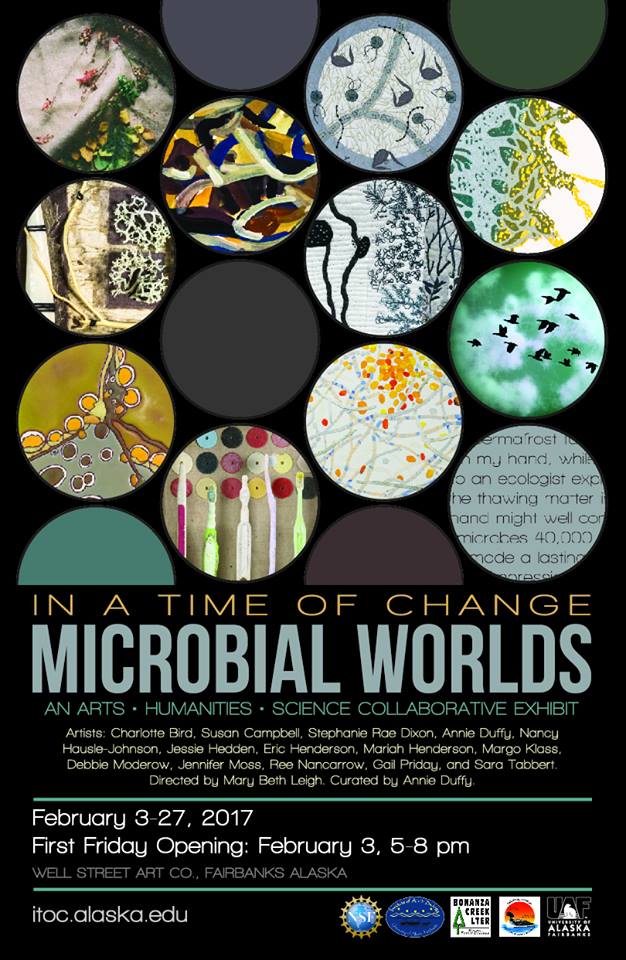
In A Time of Change: Microbial Worlds
February 3-27, 2017
Fairbanks, AK
"Microbial Worlds is the culmination of 16 months of collaborative work by visual artists, writers, and scientists on the topic of microorganisms. Microbes are the most numerous and diverse organisms on the planet; they include bacteria, fungi, protozoa, algae and viruses. While some cause disease and contribute to climate change, others are responsible for promoting human health, removing toxins from the environment, and maintaining healthy ecosystems.

Under the leadership of Leigh, artists met monthly for 16 months. With Leigh and other scientists, they learned about microbiology through lectures, laboratory activities, and field trips to Toolik Field Station, Bonanza Creek Experimental Forest, and the UAF trails to learn about mushrooms and to view microbes frozen in ice on Smith Lake. Artists were also loaned microscopes in support of their independent research. The artists interacted with over 30 scientists through the course of the program, ranging from infectious disease microbiologists to ecosystem ecologists."

Tuesday, September 20, 2016

Poetic Science: Artistic-Scientific Approximations about El Yunque

From Fred Swanson...
==================

September 8th, 2016 until March 31st, 2017 

POETIC SCIENCE: artistic-scientific approximations about El Yunque, is an interdisciplinary project created by the Museo de Arte Contemporáneo de Puerto Rico, in alliance with the USDA Forest Service - International Institute of Tropical Forestry. The project unites art and science for the purpose of celebrating Earth, the resources that Earth provides, and the resources protected under the Wilderness Act, enacted in 1964 in order to establish the National Wilderness Preservation System. The project commenced in March 2013, with an artistic residence in the El Yunque National Forest, organized together with the Aldo Leopold Wilderness Research Institute and the Colorado Art Ranch. Said residence was the first of a series of collaborations that took place in six different ecosystems in the United States throughout 2013.

The residence that took place in Puerto Rico resulted in an innovative project that creatively depicts the value and ecosystem of El Yunque National Forest and the collaboration that took place between the invited artists and scientists from the Forest Service. POETIC SCIENCE presents, for the first time, the artistic and scientific projects born from that collaboration. The exhibition title refers to the oeuvre of the scientist, philosopher and poet Aldo Leopold, considered in the United States to be the father of wildlife conservation. Leopold was the first to articulate, early in the 20th century, the concept of the “land ethic”, and who formulated a new way of thinking and acting towards the land that is still greatly relevant. To this artist/scientist, the true substance of conservation lies, not on physical projects sponsored by the government, but within the mental processes of the people.

For that reason, in addition to revising the relationship between art and science, one of the goals of this project is precisely creating awareness about the natural world and the importance of natural resources in our lives. Art and science are both the product of curiosity and awe; of the experimentation with different perspectives in order to create new forms of seeing and grasping the meaning of what surrounds us. We invite the public to initiate this personal process of exploration through the work of this group of artists and scientists that have proposed a new understanding of our Puerto Rican land.

More.

Friday, February 26, 2016

Architecture of Life exhibit

UC Berkeley has a current show that includes anatomical drawings by Ramón y Cajal that are still used in medical textbooks today. From a review by NPR:
Santiago Ramón y Cajal: Microglia in the grey
matter of the cerebral cortex, 1920.
 "We forget that it is hard to see. To paraphrase Kant (loosely), seeing without understanding is blind, even if understanding without seeing is empty. A good drawing — for example of the working parts of an engine — is often much easier to interpret than an actual perceptual encounter with the engine itself. The engine, after all, is very complicated. What is important? What deserves notice? It's hard to know. But the drawing, when it is successful, is more than a mere representation; it is, really, the exhibition of what something is, of how it works, of what it is for. A good drawing is an image that has been imbued with thought."

Architecture of Life runs through March 29, 2016 at BAMPFA, the new visual arts center of UC Berkeley.

Monday, December 7, 2015

Rot: The Afterlife of Trees

 "In 2014 Dr. Mark Harmon, a nationally recognized forest researcher from Oregon State University’s College of Forestry asked The Arts Center to help him mount an exhibition about decomposing logs. Rot: The Afterlife of Trees is a resulting multi-media exhibition coming to [the Main Gallery of the Art Center in Corvallis, Oregon] in January 2016."

Call to Artists and Scientists

CALL TO ARTISTS AND SCIENTISTS
PENCE GALLERY AND UC DAVIS ART/SCIENCE FUSION JURIED EXHIBITION 
THE CONSILIENCE OF ART AND SCIENCE 2016 
January 19 - February 28, 2016 | Reception: Friday, February 12, 6-9 PM

The goals of the exhibition are to show creative work that explores the intersection between art and science; to foster communication between the arts and sciences; and to spark new ways of viewing the world and ourselves. Creative work that transcends pure scientific illustration to explore the conceptual realm where art and science both reside is strongly encouraged. 

For more information and to apply, see this page.

ArtSciConverge partnership at Aquarium of the Pacific

"The Aquarium of the Pacific has commissioned a project that brings art and science together to
translate the movement of sea jellies, or jellyfish, into a symphony...The Symphony of Jellies was developed based on an algorithm that tracks the movements of sea jellies and translates them into sounds...

Marty Quinn, founder of the Design Rythmics Sonification Research Lab, developed software and hardware to capture sea jellies movements with digital video footage and translate them into sounds through a process he calls MoveMusic sonification. Composer Eddie Freeman of Icarus Music used those sounds to create musical motifs and orchestration. Aquarium President and CEO Dr. Jerry Schubel and Aquarium Trustee Dennis Poulsen served as advisors and partners on the project."

Schubel and Quinn are members of the ArtSciConverge effort, and met as participants in the 2015 Reno Workshop.

Tuesday, September 29, 2015

2015 London Design Festival

Some beautiful and evocative environment-themed artwork appeared at the recent 2015 London Design Festival. Here are some standouts:

"Designed by Austrian designers mischer'traxler, the installation comprises 250 mouth-blown glass globes, each containing a single laser-cut, foil-printed insect. As infrared motion sensors attached to the hanging bulbs sense a visitor's presence, the insects start to frantically fly around in their glass containers, like a cabinet of curiosities come to life."

"Designer Tino Schaedler of Optimist Design has created the first Virtual Reality experience at London Design Festival. A black fiberglass sculpture has a VR helmet for the visitor to use and experience a transformation of the room (as pictured). The team collaborated with sound designers Nordmeister from LA, to enhance the experience with spatial sound design."

"This bench is made from a unique material called Concrete Canvas, which is a mouldable version of normal concrete. The material comes as a flexible fabric which hardens when you add water to form a thin, durable, waterproof and fire-resistant concrete layer. It can be used to create temporary housing and reduces the environmental impact of concrete building by up to 95pc."

Friday, July 3, 2015

MDI Biological Lab Art Meets Science Exhibitions


From their website:

The MDI Biological Laboratory’s fourth annual Art Meets Science exhibit takes place summer 2015 at its Salisbury Cove campus. “Is It Art or Is It Science?” focuses on works that were created to be either artistic or scientific, or both, and which reflect the research interests of the Institution’s scientists.

“Both artists and scientists use creativity and the discovery process to create images of the world,” says Bonnie Gilfillan, who directs the Art Meets Science program. “You can’t always tell whether something was produced for scientific or artistic purposes. We’re interested in works that blur the boundaries between these disciplines.”...

Science and art describe the world to us and offer new ways of understanding the diverse and complex realities of life. Both share a rich history of discovery and the search for truth. Each is a tangible, physical endeavor; each relies on abstraction.

--Thanks to Leslie Ryan for the link!

Tuesday, April 7, 2015

Insight from an artist/scientist

Brandon Ballengée is a biologist, professor, and an important environmental artist. Here's a recent article where he talks about how the two intersect.
"In science one has to be very detached, to be as objective as possible and just let the data speak for itself. Whereas in art you can be coming from this idea of wonder in a very different way that can be used to captivate audiences."

Wednesday, March 4, 2015

Engaging the arts in field station collections

From the Florida Museum of Art and Culture:
"Science Bugs celebrates local ecology and research by exploring insects using three kinds of representation. 
Tim Lethbridge’s photography captures moments of insects “in the field,” giving us a glimpse into their lives and ecological roles. 
Dustin Angell’s studio-like photographic portraits offer an intimate view of specimens from scientific collections, highlighting the structures of their bodies and the scientific research related to them. 
Dr. Mark Deyrup’s scientific drawings of insects reveal the defining traits of species, and show how entomologists need standardized and highly detailed depictions of insects. 
Through these three artists, Science Bugs gives viewers a look at an important part of ecology as well as the methods of how insects are studied."
Archbold Biological Field Station provided the insect specimens.

=============
Update from Hilary:

"and even better

Our education coordinator took the startling black photos – Dustin Angell and our bug biologist Mark did the drawings – so cool

H"

Tuesday, February 24, 2015

2014 BioArt winners

"Each day, scientific investigators produce thousands of images and videos as a part of their research – from the collection of image-based data, to the visualization of results and the illustration of complex findings. However, only a few are ever seen outside of the laboratory. Through the BioArt competition, FASEB aims to share the beauty and excitement of biological research with the public."

See the 2014 BioArt winners here.

Monday, February 9, 2015

From Math to Shakespeare with Man Ray

A new exhibit at The Phillips Collection highlights Man Ray's photographs of mathematical models, displaying the objects alongside the photographs, and the later paintings they inspired.


“The mathematical models would then become specific personalities featured in Shakespeare plays that would be familiar to his audience and invite curiosity...”

Exhibition curator Wendy A. Grossman asks in her catalog essay, 'Squaring the Circle : The Math of Art', if the Surrealists used modern math in pursuit of unreality...

"Is this confluence merely coincidental, or do Surrealism and modern mathematics share something of the same spirit? Or is there something Surreal about mathematics that drew these artists to this realm?"

The full article has some interesting ideas about the collision of art and science, and is worth a read.