Showing posts with label design. Show all posts

Saturday, April 28, 2018

“What would power look like if it were art?”

Jim Mason is a Burning Man and San Francisco Bay area artist. Asking that question led Mason down a path that led to All Power Labs (APL), a $5M a year energy start up sustained entirely by sales.

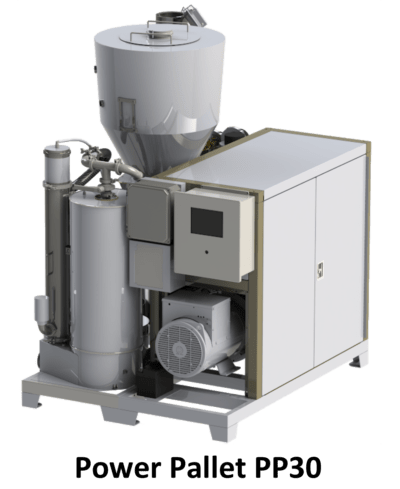
APL creates biomass gasifiers that produce heat, electricity and biochar from organic debris, creating negative carbon balance in the equation. The company actually aims to reverse the planetary damage done by burning fossil fuels over the past 150 years, moving atmospheric carbon into the soil in a stable form that enhances soil productivity over millennia. The technology is small scale for distributed production at the source of the feedstock, rather than requiring trucking of material to a large megawatt generator, as is our current cultural model...which is only better because some company can make billions that way.

Though APL's aims seem grandiose to the point of delusion, the artists are onto what may be the only solution out there, and the company is growing rapidly both domestically and world-wide.

APL's gasifiers are small, arriving on a pallet, and relatively affordable (if you have $50K and a handy source of biomass to feed it). But now, anyone can get in on the action, and improve their garden (or someone else's) at the same time: the company has borrowed the Community Supported Agriculture model and is offering biochar subscriptions through their new Local Carbon Network. You (or your designees) get periodic bags of this special charcoal shipped to your home (or farm), where you mix it with compost and till it into your soil. Your effort improves the soil productivity, reduces water needs, and banks carbon. It's worth the $25 Indie-Go-Go subscription just to support these visionaries!

Read article.


APL is not the only visionary, artist-led, Burning Man-inspired energy initiative underway.
"Black Rock Solar began its sun-capturing mission at Burning Man 2007, installing a 30-kilowatt solar power array on the playa in keeping with that year’s Green Man theme. After the event, the team donated and moved the installation to Gerlach’s Ernest Johnson Elementary School. The original array was later expanded to 90 kilowatts, providing the school with a third of its power and saving more than $15,000 per year, money that goes toward enrichment programs for the kids.  
Black Rock Solar’s financial model was innovative: use donations and grants to fund solar installations, receive significant solar rebates from Nevada’s electric utility, and use that money to fund more installations. Today, through Black Rock Solar’s efforts, more than 100 schools, non-profits and tribal community buildings, including the Pyramid Lake Paiute Tribes schools and facilities along the Route 447 stretch between Fernley and Gerlach are now powered by the sun’s rays."
In 9 years, BRS installed 7.6 megawatts worth of solar systems to generate clean, cheap power in Washoe County, Nevada, and points beyond. So much power, in fact, that the State of Nevada proclaimed Hwy 447 as America's Solar Highway, with more watts of distributed solar per mile than anywhere in the USA (451kW along 75 miles of highway, 17 watts per mile).

With the drop in solar hardware costs and the end of Nevada's incentive programs, Black Rock Solar's financing model was no longer effective; the company recently transitioned into Black Rock Labs, an accelerator for "best-in-class clean-tech innovations particularly suited to the Burning Man culture and in alignment with Burning Man principles. It will select projects that may start by bettering life in Black Rock City, but which can be scaled to serve the whole world."

One of their first efforts is the hexayurt: a simplified disaster relief shelter designed by artists and tested thoroughly on the harsh playa at Burning Man. The structures are simple, cheap, portable, and robust for use in disaster areas and other temporary communities.

More info.

Friday, April 6, 2018

Ohio River water quality/art project

As an artist I entered the project with the hopes of being inspired by something that would lead to a visual expression. I wanted my "research" to be creative and I allowed it to unfold as a series of related but diverse information gathering excursions.

Electrofishing with Chris [Lorentz, Professor of Biology, Thomas More College] gave me an understanding of the amazing ecosystem of the river itself. Next I met with the Ohio River foundation and talked about the main causes of pollution in the river. In 2015 there was a 500 mile long algae bloom on the river, and this phenomena captured my creative imagination as a subject to focus my goals. I did research about the documented history of industrial pollution on the river, and at the public library found an especially amazing photograph of the Cincinnati river bank from the 19th century.

In the photo you can clearly see the sewage run off exiting buildings at the rivers edge. In this small section of the photo you can see the open sewer ditch. The photo was taken in 1848 and the next year a cholera epidemic swept the city.

In my design courses, I try to get students to become more sensitive to color and shape as tools to shape an environment. For the algal bloom project, I met with a select group of talented students and we talked about the algal bloom as an experience, something immersive and expressive, so that we might find a way to personify it visually.

First we decided on a shape quality and the beginning of a color system. These decisions were based on principles of good design married to the specific attributes of the algal bloom. Here is a first small hand painted design. In this painting, we stuck to the literal blue green color scheme and used a botanical motif. The rectangle itself is a golden rectangle and the shapes are interacting with further golden ratio divisions within the larger rectangle.

Although this initial design is very interesting to look at, it does not embody the voracious life cycle and disruptive quality of the bloom. We took the initial painting and spent a long time working with it on the computer, mirroring and multiplying the design across a larger expanse. We changed the color to be more perceptually intense, and further intensified the relationship between the botanical shapes and the internal geometry of the design. The final design is here:

We hosted the NCBDS conference on the beginning design student here at UC a couple weeks ago, and I presented the project and printed the poster at a large scale.

I would love to display it more, either virtually or physically, Do you know of any opportunities? I have a file that can be printed at various scales, and it is a really exciting/immersive visual experience.

Cheers!

Emil Robinson
emil.robinson@gmail.com

ps I can send better quality files if needed

Sunday, December 17, 2017

Storytelling with Digital Mapping

Ouchhh Creative New Media Agency works at the interface where meaning emerges from data and digital technologies.

In addition to the expected advertising, their work includes performance art created from 3D image tracking and mapping, and inspired by scientific and mathematical topics like light physics, geometry, neuroscience, and particle physics.

Their website includes many compelling projects, including these:


Sunday, October 22, 2017

Communicating music


The idea of transcribing music is really interesting if you think about it. It is a translation of the products of one of our senses to another, like trying to translate the visual experience of, say, color into the tactile experience of touch.

But there's more than one way to interpret this task:
"It all started around 840 C.E. when a former monk named Aurelian of Réôme created one of the first examples of Western musical notation."
Read the entire article here.

Monday, May 8, 2017

"Dan Goods, JPL's science seer"

Dan Goods, "Out There" at JPL.

This article from the LA Times archive profiles Dan Goods: Jet Propulsion Labs' (JPL) resident "Visual Strategist". Some quotes from Dan:
"I love the theme of seeing the unseen." 
"Everyone should have the opportunity to have a moment of awe about the universe. If I can create that, then I feel I've been successful."

"I've always had a good reaction [from scientists]. Sometimes their inner geek comes out: 'How did you do that?' These are huge problems these people are working on, really difficult and technical, and sometimes they forget about the big picture. So when I show them something, they're like, 'Yeah, that's why I'm doing this.' Now people come to me when they want something from a different perspective. They say, 'Oh, we should just go talk to Dan.'"
See more of Dan's work at his website:
http://www.directedplay.com/

And on his Vimeo channel:
https://vimeo.com/dangoods

Friday, October 28, 2016

ArtScience Labs

"Le Laboratoire Cambridge is an interdisciplinary culture lab that invites visitors to explore the experiments and wonders of innovative artists, designers, chefs, and more discovering at the frontiers of science. 
Founded in Paris in 2007 by inventor, material scientist, and Harvard Professor David Edwards, Le Laboratoire now lives in Cambridge as the flagship of ArtScience Labs, a global organization dedicated to radical idea development."
* * *

Le Laboratoire is part of a larger effort at art/sci convergence for cultural change called, Artscience Labs.
"Culture labs conduct or invite experiments in art and design to explore contemporary questions that seem hard or even impossible to address in more conventional science and engineering labs."
"Many of the questions that we face today — questions of innovation, of change — are not really questions we can deal with in a classical science lab."


"Labs are places of experience. We enter to explore. Each minute in a functioning lab is like a page of a smart novel that loses meaning without reference to what came before and is about to follow. 
Art, like science, is such an experience, and, yet, we encounter art and science in our museums more frequently as outcome, as product – dug up, carved down, highly edited – that follows a mysterious process of creative thought and engagement... 
At The Laboratory, we look for novel ideas of art and design that cannot be properly formulated without a sustained encounter with a pioneering edge of science. We then help broker encounters between artists and scientists that permit concrete idea formulation. Once ideas are formulated, we invest in development of the experimental projects that result. In this way, artscience, the process of creative thought that synthesizes esthetic and analytical methods, becomes a catalyst for innovation and the basis for partnership."
ArtScience Labs includes an educational program called the ArtScience Prize, a global "catalyst for student learning through passionate pursuit of innovative art and design ideas at the cutting edge of science...the ArtScience Prize [is] an interdisciplinary education program that supports young people as they explore and develop groundbreaking ideas around an annual scientific theme, seek[ing] to prepare the next generation of innovators."

2013-14 Boston ArtScience Prize from ArtScience Prize on Vimeo.


The winners of all the ArtScience Prize programs are invited to the annual ArtScience Labs Annual Innovation Workshop, which is like a Silicon Valley development incubator.

2015 ArtScience Innovation Workshop from ArtScience Prize on Vimeo.

More videos from ArtScience Labs on Vimeo and Youtube 1 | 2.
Books on ArtScience by David Edwards:


Wednesday, September 30, 2015

The gap between thinking and doing

There's an interesting article in Wired UK this month about art/science convergence, though it isn't presented as such.

Artist Olafur Eliasson is a hybrid. A artist who was first a trained draftsman and architect, whose interest in bodies and spaces came out of his experience as a teenaged break dancer.


In his parent's homeland of Iceland, "he learned the power of defamiliarisation - the feeling you have when seeing things presented in a surprising way that makes you feel you're seeing them for the first time."

As an artist, Eliasson is interested in, "How do I take a feeling I carry within myself and give it shape? What's the gap between thinking and doing, idea and action?" Everyone at his highly collaborative 90-person studio is pushing for "non-quantifiable success criteria".

"Something you can neither see nor feel is hard to think about and easy to ignore; religion is helped by its icons and ritual, whereas environmentalists must rely on over-familiar, depressing footage of melting ice caps and denuded rainforest."

"Fundamental to Eliasson's work is the belief, rooted in phenomenology and gestalt psychology, that in changing an individuals' perception of their surroundings, art actually changes the world. The studio is based on a shared conviction on art and creativity as means of change, and 'because we are looking at things from an artistic angle, we consider things relevant that other people would not.'"

Eliasson is interested in somatic knowledge. "How do we change the world and push it away from being so obsessive with measurable success results?" he asks.

It seems to me that this somatic response is the thing that underlies science, and makes us care enough to do that work in the first place.

But, as with Eliasson, inchoate interest in phenomena can just as easily manifest itself as art. Or both simultaneously: FSML as exploratory art studio in service of basic scientific discovery.

Tuesday, September 29, 2015

2015 London Design Festival

Some beautiful and evocative environment-themed artwork appeared at the recent 2015 London Design Festival. Here are some standouts:

"Designed by Austrian designers mischer'traxler, the installation comprises 250 mouth-blown glass globes, each containing a single laser-cut, foil-printed insect. As infrared motion sensors attached to the hanging bulbs sense a visitor's presence, the insects start to frantically fly around in their glass containers, like a cabinet of curiosities come to life."

"Designer Tino Schaedler of Optimist Design has created the first Virtual Reality experience at London Design Festival. A black fiberglass sculpture has a VR helmet for the visitor to use and experience a transformation of the room (as pictured). The team collaborated with sound designers Nordmeister from LA, to enhance the experience with spatial sound design."

"This bench is made from a unique material called Concrete Canvas, which is a mouldable version of normal concrete. The material comes as a flexible fabric which hardens when you add water to form a thin, durable, waterproof and fire-resistant concrete layer. It can be used to create temporary housing and reduces the environmental impact of concrete building by up to 95pc."

Friday, June 12, 2015

How do you institutionalize art at field research sites?


Here's one clever and simple idea: give artists a dedicated place to stay while on site. This is a cool project proposal from Stanford, forwarded by Philippe Cohen. The funding was an internal Stanford competitive grant program under the auspices of the Stanford Art Institute.
"What really excites me about this is that it will have the effect of normalizing the presence of artists and art students at Jasper Ridge [Biological Preserve] and set the stage for interactions and collaborations between artists and researchers."

Thursday, December 18, 2014

Stories generate culture

Field science has not always done a great job of connecting itself to the broader culture in a way that resonates. Left with a vacuum, politicians and the media often step in to help the public figure out what emerging science means. Their messages are not always what the scientific community would prefer.

Gwen provided this link to an excellent report that points out that, "Our brains are designed for stories. They are the best way for us to grasp deep truths. Understand a complicated sprawl of facts." The document provides some interesting ideas about using story to convey messaging.

Researchers in many fields are discovering hard evidence that stories shape culture. This video suggests that the even the scientific theories of seminal thinkers like Darwin were shaped by their literary preferences, and not always toward greater accuracy.

Tuesday, November 11, 2014

Data Carpentry

Data Carpentry is a new project funded by NSF BIO Centers and DataOne. It is designed to teach researchers basic concepts, skills and tools for working more effectively with data.

Workshops are designed for learners with little to no prior knowledge of programming, shell scripting, or command line tools.

iDigBio recently hosted a Data Carpentry workshop, and their website has good documentation.

It occurs to me that this workshop offers an interesting opportunity to train both scientists and artists, while providing the possibility of interaction.

Looking at the rapidly expanding pool of data as a resource, or a medium, offers interesting potential art/science collisions. For example, Artist-Scientists Fernanda Viégas and Martin Wattenberg lead Google's "Big Picture" visualization research group in Cambridge, Massachusetts. They created a compelling art project from wind data that you have probably seen, as well as many internet data visualizations , including Many Eyes, an on-line data visualization tool, Wikipedia, chat history and e-mail visualizations.

More thoughts about data visualization here.

New brochure for NAS Report

This is a new brochure from OBFS and NAML, highlighting the recent National Academy of Sciences report on "Enhancing the Value and Sustainability of Field Stations in the 21st Century".

Designed to present the salient points quickly and clearly to elected officials, campus administrators, grantors, and anyone else who has influence on field station and marine lab funding, this piece can also serve as an argument for art at FSMLs. In order to accomplish the recommendations of the report, FSMLs will need to engage a broader audience than in the past, linking the chain from data > knowledge > empathy > policy > action.

Art can help us do that.

Tuesday, September 30, 2014

2014 National Academy of Sciences report on FSMLs

Updated 6-25-15:

Dr. Jerry Schubel, President and CEO of the Aquarium of the Pacific in Long Beach, CA presented to us at the Wood's Hole OBFS/NAML Joint Meeting on the recent National Academy of Sciences report on "Enhancing the Value and Sustainability of Field Stations and Marine Labs in the 21st Century" (there is also a short Report In Brief available for the publication, and an OBFS-produced synopsis trifold).

The report process produced a useful catalog of worldwide field stations.

Here's a PowerPoint link. Jerry also used the video below in his presentation:


I followed up with Dr. Schubel about the model he described in that presentation, a chain of progression from data > knowledge > wisdom > policy > action. At the meeting, he scolded the FSML community for failing to reach the latter links in the chain. It's not enough to discover and "know" things. We have to connect this knowledge through to our larger culture. As research facilities, our survival depends on it.

But how do we do that, if it's not a scientific process? Maybe art can help? Dr. Schubel thinks so, too. Though it was missed in the report, he did a follow-up Viewpoint article in BioScience that states that FSMLs are ideally suited for facilitating interdisciplinary "creative abrasion". He specifically identifies the critical need to include arts and humanities.

He recommended that I check out a program from the aquarium: "The Role of Design and Design Thinking in Sustainability and Ocean Conservation". There is a Livestream video of the conference, and a Coastal Conversation video on the same topic.

Thoughts?