The two laureates will receive a production grant up to 10,000 euros depending on the project, workspace and residential accommodation at ThalieLab in Brussels.
"Public Lab is a community where you can learn how to investigate environmental concerns. Using inexpensive DIY techniques, we seek to change how people see the world in environmental, social, and political terms.
I. The Problem
Communities lack access to the tools and techniques needed to participate in decisions being made about their communities, especially when facing environmental hazards.
II. The Collaboration
We are an open network of community organizers, educators, technologists and researchers working to create low cost solutions for monitoring air, water and land.
Discover, collaborate on, and contribute to locally important matters with the support of a global community.
III. The Solution
Join us today, as we work together to build and inspire a community of DIY activists and explorers using simple tools to build a growing body of data about our local environments."
The idea of transcribing music is really interesting if you think about it. It is a translation of the products of one of our senses to another, like trying to translate the visual experience of, say, color into the tactile experience of touch.
But there's more than one way to interpret this task:
So divinely is the world organized that every one of us, in our place and time, is in
balance with everything else. Johann Wolfgang von Goethe
Balance is defined as a condition in which various elements are in proper proportion or arrangement. Within
an ecosystem, balance is key in maintaining a harmonious interaction among a biological community of
interacting organisms and their environment. Balance is also a vital component in music. A composer’s
concern for balance can be heard through the manipulation of many musical elements including form,
melody, harmony, rhythm and texture.
The 2017-2018 Learning in Concert program will explore the concept of balance in music and ecology.
The children will explore various ecosystems to analyze whether it demonstrates elements of stability or
imbalance. By focusing on ecological instability threatening salt marshes, rain forests and wetlands, the
children will identify specific actions or ideas that could help restore ecological balance to these areas. In
music, the children will explore balance in classical music—hear how composers achieve balance through
the orchestration of musical parts among musical instruments. They will develop a strong understanding of
the various instruments of the orchestra and hear how individual instruments, sections and families interact
to achieve balance within a piece of music. Children will analyze balance cross-disciplines by determining
niche (the musical part’s role in creating balance within a piece of music and the organism’s role in creating
balance within an ecosystem), population (number of the same species within an ecosystem or number of
same instruments playing within a piece of music), and biodiversity (how many different musical parts
transpire and interact throughout a piece of music or how many different species exist within an ecosystem).
In the classrooms, the children will analyze various ecosystems that are in some state of ecological
imbalance. Using a large magnetic “Ecostration” board, animal and plant life magnets and sound recordings
of various orchestral instruments as their tools, they will orchestrate a section of music that demonstrates
the instability found in their selected environment. The children will first determine what level of stability
exists in the base with microbes and represent that stability through the selection and scoring of a bass line
for their music. They will then analyze the balance of the plant life in the ecosystem and select supporting
harmonic material to represent the plant life’s stability. Lastly, the students will add melodic lines to represent
the population and diversity of species within the ecosystem. Through classroom discussions and research,
the children will identify potential actions or interventions that might begin to restore balance to this
environment. With these actions in mind, the children will adapt and change their orchestration to
demonstrate the ecosystem moving from a state of imbalance towards a state of balance.
Students will have also have an opportunity to interact with the NBSO Salt Marsh Model. They will work
through several scenarios to explore a salt marsh food web and how development, pollution and tidal
restriction effects the balance within a New England salt marsh...
Contact Terry Wolkowicz to bring the “Learning in Concert” program to
your school!
email: twolkowicz@nbsymphony.org
phone: 508-493-4288
LaynaJoy Rivas and Eva Reiska’s “Sysimetsä”, a memorial
for those affected by the fires that destroyed Lake County, as
well as for a beloved art space by the name of
Ravens Landing back in 2015.
1. Trees (and/or forests) are iconic symbols in virtually every culture;
2. Western US forests are in crisis.
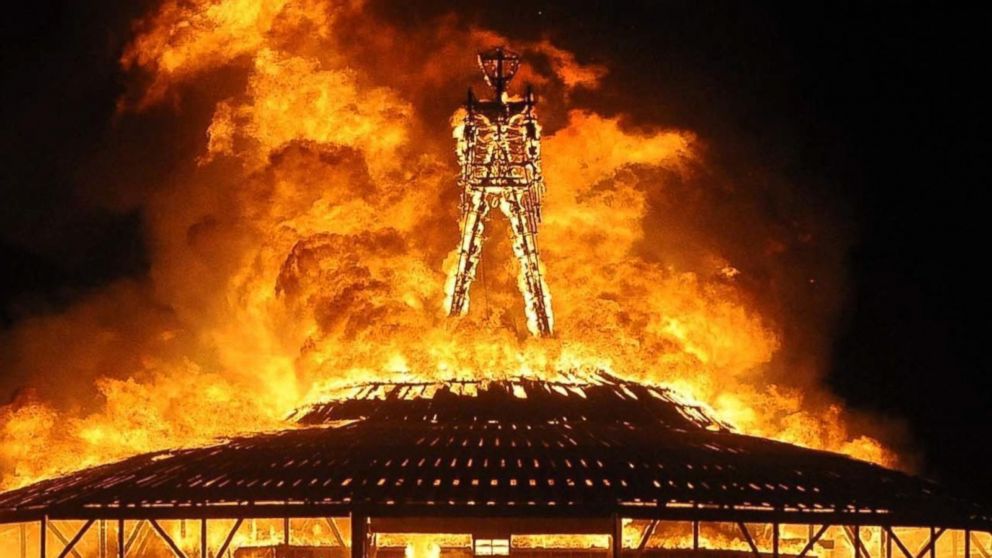
Combining or juxtaposing previously unrelated ideas is how humans create new knowledge, whether with art or science. So, how are artists combining these two ideas at Burning Man, one of the country's most controversial art events?
"Ursa Mator," by Mr. and Mrs. Ferguson: a gorgeous
sculpture covered in shimmering, edge-wise pennies takes on additional meaning as the Man burns in the background. Large wildfire destroys forest ecosystems, including iconic wildlife.
The most significant of these conceptual artworks was undoubtedly The Temple. Each year, a Temple is constructed as a locus of communal and personal release. People post photos, stories, keepsakes, mementos and messages relating to loved ones they have lost, or issues they are struggling with. The entire Temple is then burned to the ground on the last evening of the weeklong event in a solemn, silent ritual of cleansing and renewal that counters the rowdy, Saturnalian burning of the Man structure on the previous evening.
This year, the Temple architects chose to highlight western forest health problems by using lumber milled from dead salvage logs. This forest health theme is aligned nicely with the purpose and function of both the Temple, and the entire Burning Man ethos, which aims to alter attitudes of citizens in order to address systemic dysfunction in western culture.
Burning Man is not the only group of artists working on forest issues, of course. Some artists are actively trying to change social policy.
Saving The West (STW) is a UC Santa Cruz-based, artist-led group working to create a new kind of timber industry that can use the small, torchy material that needs to come off of dry western forests in order to restore ecological function and resiliency. Without industry, there is no way to pay for the work that everyone, including loggers and environmentalists, now knows needs to be done. Meanwhile, our precious forests will continue to die off and/or burn. The current timber industry has retracted so far, and is still so focused on large trees--and lucrative salvage logging of the standing dead--that it is not useful at all in addressing this problem. Unfortunately, it's good business to let the forests continue to die.
STW recently received a grant from the US Forest Service to start a bi-state Wood Utilization Team working in California and Nevada in the Central Sierra Nevada Mountains.
"The Cambridge Conservation Initiative (CCI) is a unique collaboration between the University of Cambridge and leading internationally-focused biodiversity conservation organisations clustered in and around Cambridge, UK.
CCI seeks to transform the global understanding and conservation of biodiversity and the natural capital it represents and, through this, secure a sustainable future for all life on Earth. The CCI partners together combine and integrate research, education, policy and practice to create innovative solutions for society and to foster conservation learning and leadership."
Matt works in Fundraising for the RSPB Eastern England team. He will be spending his month of sabbatical time at CCI as our first poet in residence, starting on Monday 14 August.
Part of Matt’s role with RSPB is to explore engagement with the arts and he is the lead on the RSPB / The Rialto Nature and Place poetry competition which now additionally partners with CCI and BirdLife.
Matt’s poetry has been published in leading international magazines and journals such as The Poetry Review, New Statesman and The Dark Horse. His debut pamphlet, The Organ Box, was published in 2014.
Throughout his sabbatical, Matt will be based in the Artist in Residence studio (floor 2M of the East Tower). He will break his time up into one week a month, and he will also be at CCI some Fridays over the next few months.
In addition to providing Matt with time to write and network at CCI, the residency has a number of ambitions, all with the aim to gain a deeper understanding of how creative writing can help provide public engagement opportunities and deliver conservation objectives. Matt will be working to:
Host poetry events at CCI with leading poets
Develop the Nature and Place competition to increase its fundraising potential
Work with Modern Poetry in Translation magazine on an issue of international environmental poetry
Facilitate opportunities for other early career poets to engage with CCI to produce new work for publication and performance.
Matt will also offer colleagues from CCI member organisations opportunities to engage with the residency. Opportunities include:
One to ones with people interested in developing their own writing and reading
Establish a workshop group for those interested in writing new poems
Joining a mailing list to receive a fortnightly poem from the existing canon on a nature / conservation theme, with an explanatory note by him.
Matt is contactable on matt.howard@rspb.org.uk, please do get in touch if you are interested in getting involved.
Information on the intranet can be found here.