Monday, September 19, 2016

Ars Biotica

From Ariane Koek:

=======================

Ars Biotica is a long term art and science collaboration between the Finnish society of Bioart, and Kilpisjarvi Biological Station which belongs of the Faculty of Biological and Environmental Sciences of the University of Helsinki. It has fostered interdisciplinary work since 2008, hosting arts and science activities as well as an artist in residency programme. The focus of the work is on Arctic nature, biology and ecology, with a special interested in the biology of war, snow and ice, environmental and climate change, and the relations between nature and culture perceived
through the lens of art and science.

Since 2010, around 40 artists from Finland and abroad have participated in the Ars-Bioarctica artist residency programme.

They have also hosted a biennial art and science field lab called Field_Notes that took place in 2011 and 2013. These labs were about supporting artistic fieldwork as a catalyst for other environmental
investigations.

Currently the majority of collaborations between the artists and the scientists have been initiated by the artists.

http://bioartsociety.fi/ars-bioarctica
http://bioartsociety.fi/ars-bioarctica-residency
Blog... http://www.bioartsociety.fi/residency/

Balance-Unbalance, 2016


Balance-Unbalance (BunB) is an International Conference designed to use ART as a catalyst to explore intersections between NATURE, SCIENCE, TECHNOLOGY and SOCIETY as we move into an era of both unprecedented ecological threats and transdisciplinary possibilities.

The theme for BunB 2016 was “Data Science + Eco Action”.
How can we extract knowledge from large volumes of environmental and related data? How that can be used in benefit of the human society? What should we change in our thinking and in our behaviour? Individual vs community vs global: What matters? Why big or complex data is so relevant to our daily life? How the capture, analysis, curation, sharing, storage… and control of large data could rapidly change our world? What positive sides does it have? What not so positive, and even risks does it have? What data science has to do with humanitarian organizations? And with electronic art?

We want to inspire explorations of how artists can participate in this major challenge of our ecological crisis. We need to use creative tools and transdisciplinary action to create perceptual, intellectual and pragmatic changes. We want to discuss our proposals for the future from a diversity of cultural perspectives and socio-economic situations with open minds.
If you want to know more about Balance-Unbalance and its associated projects, please download:

Past BunB conferences:
(Thanks to Ariane Koek for the reference)

Monday, August 22, 2016

Recent scholarship on art/science

Here are some interesting recent publications at the art/sci interface:


The Routledge Companion to the Environmental Humanities

Abstract:
The Routledge Companion to the Environmental Humanities, edited by Ursula K. Heise, Jon Christensen, and Michelle Niemann, is a collection of 45 essays, many of which were first drafted for the UCLA Sawyer Seminar on the Environmental Humanities in 2014-2015. It will be published in late 2016 or early 2017; see the table of contents below for a sneak peak. The volume brings together work by an international, interdisciplinary group of scholars and writers who address the Anthropocene, domestication, posthumanism, multispecies communities, narratives of decline and resilience, environmental history and memory, literature and ecocriticism, and environmental media, technologies, and art. The result is an important reflection on and assessment of the environmental humanities now.

More Info: Forthcoming in late 2016 or early 2017


Combining Art and Science for Conservation Outreach of Ectothermic Vertebrates (Amphibians and Fishes), Brandon Ballengee & Prosanta Chakrabarty

Abstract: 

Although artists and biologists tend to stay confined to their professional boundaries, and their discourses largely remain inaccessible to larger audiences, evidence is presented here for a combined approach, which may affectively disseminate knowledge about amphibians and fishes to non-specialists through novel art-science participatory research and exhibitions. In this study evidence is presented that suggests combining art with biology may successfully increase public understanding of the international decline of amphibian and fish populations, as members of the public achieved increased understanding of ectothermic vertebrate conservation issues through direct participation (citizen science) in primary scientific studies. Likewise, art inspired from these research experiences was exhibited internationally with the intention of furthering a conservation message and results from questionnaires suggests visitors gained an increased awareness of the threats many species of amphibians and fishes currently face. Historically many scientists utilized varied creative art forms to disseminate scientific insights to a larger populace of non-specialists, such strategies as visually provocative artworks may still be effective to captivate contemporary audiences. As today's environmental issues are often complex and large-scale, finding effective strategies that encourage public awareness and stewardship maybe paramount for long-term conservation of species and ecosystems.


Constructing reality - The Museum of Jurassic Technology
Mapping the Musesphere - Cultures of Exhibition and Technologies of Display MPhil/PhD, Media and Communications, Goldsmiths College, University of London, 2006, Chapter 5 - Displaying Mimesis: Fakes, Facsimiles and Fabrications

While we might be confident in our faith in our fakes, we have a different kind of faith in museums. Through their traditions of integrity and open-door policy, and as inscribed in legislation, museums assure their public of their authority to collect, conserve and exhibit the cultural heritage on behalf of their public... Confounding the very notion of the integrity of the museum to tell the truth, though, the Museum of Jurassic Technology in Los Angeles, California tells another story. Promoted as an educational institution dedicated to the advancement of knowledge and the public appreciation of the Lower Jurassic, their narratives do not fall into any known museum categories.

Thursday, June 30, 2016

Realising Potentials: Arts-based sustainability science

Realising Potentials: Arts-based sustainability science is a two-day workshop conceived as an experiential site for exploration and dialogue around arts-based sustainability science.

Two main motivations guide the workshop:
  1. To open up an experiential space where artists and scientists can share, connect and expand different experiences, projects and discussions in the field of arts-based sustainability research. A space to experience others’ approaches, to play, to be surprised… A space to explore together, pushing our boundaries, acting/thinking out of the box.
  2. To catalyse a network of Arts-based Sustainability Science as a community of learning, practice and mutual support. A network expanding in time the sharing of the workshop and connecting different actors working in the field, so as to allow us to critically approach and expand different practices, collaborate together, and face different challenges as they emerge.
When and where?

The workshop will be held in Barcelona (Spain), in November 3rd-4th, 2016 at the Institute of Catalan Studies (Institut d’Estudis Catalans, IEC).

How?

During the workshop, participants will engage in different experiential laboratories and discussions to share, collectively explore and critically inquire different experiences of arts-science hybridation -both from artists and researchers, methodological boundaries and challenges as sustainability researchers and practitioners, and the potentials of bringing together the arts and the aesthetics and sustainability science.

Who?

This workshop is coordinated by a group of sustainability scientists and practitioners who have experimented with a variety of arts-based approaches and it is open to both artists and researchers interested in this intersection.

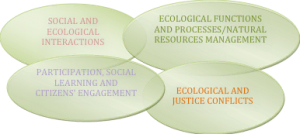
Participants are invited to share art and research projects directly developed within collaborations among artists and scientists, dealing with one of the thematic areas in question. Understanding the four pillars of sustainability – environmental, social, cultural and economic - proposals should embed the interactions between social and natural sciences and the arts as insightful ways to generate new understandings and relationships, make people aware of the importance of a balanced relationship between human beings and the environment, in its diverse levels, and trying to encourage people to realize potentials as agents of social-ecological transformations.

More details.

Friday, June 17, 2016

CFP: Ecology and Society

From Susan Jacobson:
Editors-in-Chief Carl Folke and Lance Gunderson are pleased to announce the publication of Volume 20, Issue 4 of Ecology and Society
The Reconciling Art and Science for Sustainability special feature edited by Frances Westley, Marten Scheffer, and Carl Folke will remain open to submissions until July 2016. This feature invites papers on the topic of how art and science may be integrated for transformative understanding, increased motivation and new insights.
"Why is science  perceived as entirely different from art? Both attempt to capture the essence of the world around us in novel and eye-opening ways. Still, the approaches are strikingly complementary. This suggests the potential for synergy. What can we learn from each other when it comes to the process of creative inquiry? Could we cooperate to fathom the unknown unknowns, finding important new questions that we had never thought of? This special feature invites papers on the topic of how art and science may be integrated for transformative understanding, increased motivation and new insights into how to build social ecological resilience."

Note: page charges may apply.

Friday, June 10, 2016

Report on University Artist-in-Residence Programs


Stephen Tonsor at the Carnegie Natural History Museum directed us to this 2013 document produced by The Studio for Creative Inquiry at Carnegie Mellon University.

It's a set of recommendations for artist in residence programs at universities, based on a survey of 14 universities, and paying special attention to the IP issues. The recommendations could also be very helpful to FSML art programs, as well.

Thursday, June 9, 2016

The Confluence Projects, Todd Gilens


Artist Todd Gilens works with Sagehen Creek Field Station outside of Truckee, CA and Reno, NV, and the Sierra Nevada Aquatic Research Lab (SNARL) near Mammoth Lakes, CA. His work there includes:
"...literature reviews, interviews and field work with researchers to understand the language, methods and motivations of stream science, as well as how streams are responding to climate changes."
Gilens has been working in the field and lab with invertebrate biologists David Herbst, Bruce Medhurst and Ian Bell, "considering how to bring aspects of their work to the average urban citizen".

A recent post from the artist's project newsletter illuminates some of the work emerging from that relationship.

From Gilen's crowd-funding website:
In my artworks, I borrow lecture halls, public transit vehicles, nursery propagation houses and other existing structures, adding images that make their meanings more legible. This new project emerged from visits to ecological field stations, where I compared my methods to those of field scientists’ and considered how both could inform our understanding of critical urban systems.  
“Confluence” will use the tops of urban curbs as a space to communicate with pedestrians about flowing water, stream science and the urbanization of landscapes. Using script fonts derived from local historical people’s handwriting, texts will be cut from bright yellow reflective traffic-marking tape and laid down along a mile of curbs, zigzagging from block to block on routes that follow the street grid overlay of former stream channels.