Showing posts with label emotion. Show all posts

Friday, October 12, 2018

Art, Science and Democracy...and FSMLs

"Democracy is the art and science of running the circus from the monkey cage." -- H. L. Mencken


  Democracy and Science...

"The relation of science and democracy is an ancient conundrum that continues to generate public controversy. Whenever science produces an “inconvenient truth”—as Al Gore famously calls the science of climate change—democratic governments may be tempted to ignore or suppress it. And as scientists like to remind us, 'You can’t vote on the laws of physics!'
Natural scientists and their advocates often argue that the power of science in democracy depends on it remaining insulated from politics. Seen in this light, it is no wonder that many believe science and democracy tend to undermine each other. But another long tradition sees science and democracy as mutually reinforcing. Democracies depend on science for effectively addressing public problems, and many argue that science provides a model of rational democratic deliberation.
These two conflicting interpretations each capture part of the story, but they neglect some of the most interesting questions, which concern changes in the meaning and purpose of science and democracy and how they shape each other in particular contexts. With regard to science, most scholars who study science and democracy now reject the long dominant “positivist” view of science as a formal, logical, socially insulated method for producing value-free knowledge. The ideal of value-free science remains popular in public life, but extensive research in the social sciences and humanities has shown how science is intertwined with social values, commercial pressures, and political decisions.
That does not mean science merely reflects dominant interests, as caricatures of “social constructivism” assert, but it does open up difficult questions about how democratic citizens might shape the science that shapes their lives. With regard to democracy, mid-20th-century political scientists tended to conceive democracy narrowly in terms of popular elections and formal state institutions. Recent scholarship, in contrast, shows how social institutions and material practices of all kinds may become sites of democratic politics. Indeed, as democracy has increased in global popularity, its meaning has become increasingly diffuse and ambiguous; democracy offers both a rallying cry for social justice movements and a marketing slogan for global corporations.
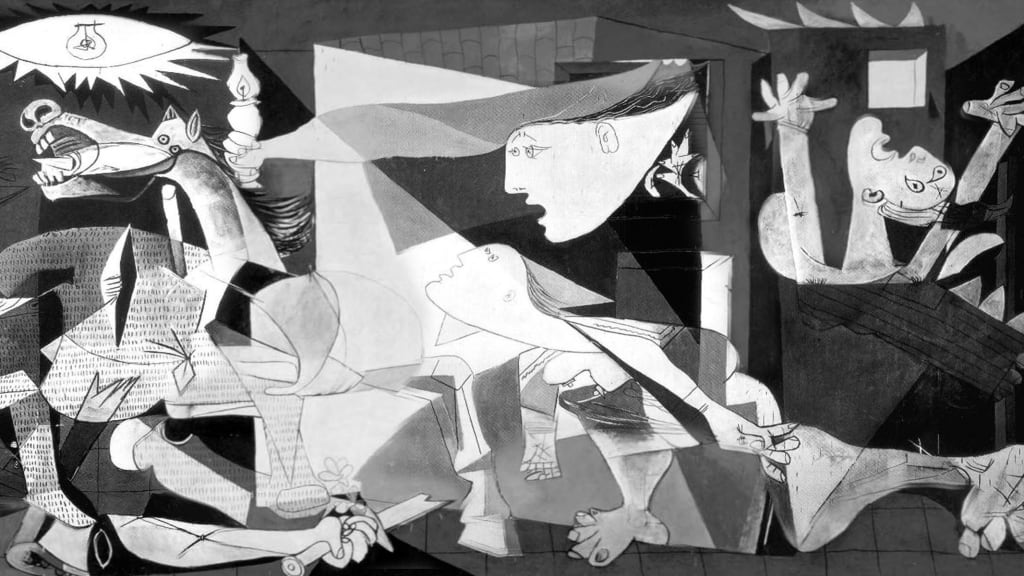
Picasso's Guernica
The relation of science and democracy involves a wide range of disparate phenomena, including science advice, science policy, public engagement in sociotechnical controversies, lay-expert relations, and the technical constitution of democratic citizens, not to mention the many specific concerns associated with issues like climate change, genetic engineering, or nanotechnology."

If science is not value-neutral, who decides how it is politicized?


Democracy and Art...

"Our leaders and institutions appear to be ill-equipped to deal with the most pressing global challenges because of particular interests that make global governance institutions weak [despite clear science]. There is a mismatch between the fragmentation of specialized institutions and the interconnectedness and complexity of today’s world.

Arts and culture have a direct bearing on our capacity to face today’s complex issues. Art safeguards a long-term view; not only does it provide a counterweight to the fast evolving world of technology, but it also helps to make sense of this world. Art invites participation and thus transcends the division between observation and activism. Art inspires insights that resonate across disciplines. Art helps to situate science and technology in public space by symbolically and reflexively representing their roles in society. Art fosters imagination and creativity, capacities that are crucial in its impact on the individual and the community."

Science, Art and Social Change...


Schubel 2015.
We need artists to bridge the gap between science's data and knowledge, to the policy that leads to cultural change. For FSMLs, this typically swirls around the Grand Challenges in Environmental Sciences.

"...unlike political consensus--once scientific consensus is reached and knowledge has been created from data, that doesn't mean there has actually been any connection made to public opinion, nor to the mechanisms of social change. Art can fill this disconnect, and has frequently been used by politicians as a tool to effect change in the working of the world."

Sunday, November 5, 2017

Article from Conservation Biology, and book from Oxford Press

Here's an interesting 2007 article by Jacobson, McDuff and Monroe from the journal Conservation Biology, titled Promoting Conservation through the Arts: Outreach for Hearts and Minds:
Emotions play a central role in the decisions we make. For example, we often make poor investment choices because we are driven by our emotions rather than rational judgment (Tversky & Kahneman 1991). On the positive side, when emotional input is added to learning experiences, it makes them more memorable and exciting. The brain deems the information more important and enhances memory of the event. Presenting facts alone is less likely to result in long-term changes in feelings and behaviors (Sylwester 1994; Weiss 2000; Cable & Ernst 2003). 
The arts offer a way to make an emotional connection to people, and the visual and performing arts can help conservation practitioners reach new audiences. Art can provoke reactions that typical education and outreach methods do not. Art has the potential to inform audiences or participants in a new way about conservation topics, and it can stimulate new dialogues and actions...


The essay was based in part on the planning, implementation, and evaluation guidelines for using the arts in conservation, published as a meaty and thought-provoking chapter in Conservation Education and Outreach Techniques, Susan K. Jacobson, Mallory D. McDuff, and Martha C. Monroe.


Tuesday, June 27, 2017

Science Needs Story

A recent article in Medium has some good advice:
"Scientists need to tell their stories — stories about why they became scientists and what science has done and is doing for humanity. Remember, science is an abstract, intellectual process for most people. It is very hard for people to gain an emotional connection to science. That’s what narrative is for."
"Top GOP messaging strategist Frank Luntz gave this advice in his infamous 2002 memo to conservatives and team Bush about how to pretend you care about the climate while opposing serious action: 'A compelling story, even if factually inaccurate, can be more emotionally compelling than a dry recitation of the truth.' ...scientists have been trained to depersonalize their speeches, to speak literally, not figuratively. As a result, it has been easy for the Luntz-Trump crowd to create stories in which scientists are the villains."
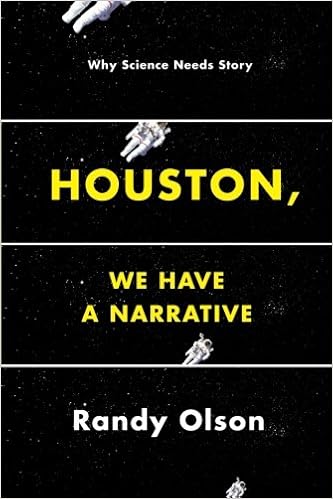
The article recommends this book for advice on crafting stories: Houston, We Have A Narrative: Why Science Needs Story, by marine biologist turned filmmaker, Randy Olson:
"Olson first diagnoses the problem: When scientists tell us about their work, they pile one moment and one detail atop another moment and another detail—a stultifying procession of “and, and, and.” What we need instead is an understanding of the basic elements of story, the narrative structures that our brains are all but hardwired to look for—which Olson boils down, brilliantly, to “And, But, Therefore,” or ABT. At a stroke, the ABT approach introduces momentum (“And”), conflict (“But”), and resolution (“Therefore”)—the fundamental building blocks of story."


Monday, June 19, 2017

On Sustainability and Art: artist Hannalie Coetzee

Fire-created artwork.
ART AFRICA looks at the practice of artist Hannelie Coetzee. "Hannelie Coetzee’s artwork draws attention to our warped relationship with nature through pragmatic, solution oriented interventions."

The article also includes highlights of a fascinating discussion between the artist's associates and collaborators.

Some interesting quotes from the article:
The more intuitive approach of artists can provide a window into the complex models, calculations and simulations of the scientific world… Natural world issues require more than just a technical fix. They require systems of thinking and creativity to imagine and illustrate the best possible solutions. -- Prof. Caroline Digby from the Wits Centre for Sustainability in Mining and Industry
Sustainability is not primarily a scientific problem; rather, it requires us as citizens, communities and societies to rethink the way in which we live our personal lives… This requires engaging the hearts, minds and imaginations of a wide set of people across many different spheres of society. Artists have a particularly important role to play in this regard – not only in creating a space that can help bridge and connect between different actors, but in contributing and opening our minds to completely new ways of seeing the world and our place in it. -- Dr. Reinette Biggs of the Stockholm Resilience Institute and the University of Stellenbosch
How can art and science integrate into a discipline or collaboration that aids transformative understanding?

Art is the expression of creative ideas that are likely informed by prior knowledge but not restricted by natural, economic or social rules. Science is a knowledge that we have built through methodical enquiry over many generations into how nature, economics and society work. When art is introduced into science, it gives permission to seek different ways of addressing the same problem. It enables one to leapfrog or do a U-turn. As stated in New Roles for Art Are Clarified (Carney 2010), Tim Collins declares that, “while replicable fact is the domain of science, human perception and value are the domains of art and the humanities. – Philipp Kirsch, University of Queensland

How do such partnerships reach wider audiences?

I have been astounded by how much easier it is to interest people in the science when it is encompassed in an artwork. Before, I was only talking to the small community of people who were already thinking about these issues. People like the art – and they like the idea that the art has some scientifc substance behind it. Some, not all of them, want to know more details about our science questions and I am challenged to maintain their interest and expand it. – Sally Archibald, WITS
How can partnerships between artists and scientists contribute to resilient systems and change?

The data on climate change is indisputable, but how does one develop an emotional appreciation of the potential consequences? I think this must come through experience and art is a fantastic mechanism to develop emotional experiences and consider possibilities. – Caroline Lehmann, Biogeography, University of Edinburgh

How has an artist’s work influenced your work and vice versa?

Hannelie sometimes brings aspects that I think of as ‘outside’ the system, into the discussion. At its simplest, ecology is the study of the interactions between organisms and their environment and it is refreshing to have a different take on the shape and form of these interactions. – Sally Archibald

I started to write a conference paper about the potential to re-imagine mining overburden as a building material. To change the way that the industry framed everything as waste rock, waste dumps, waste piles etc. In researching this, I uncovered the genre of Land Art. These artists have given considerable thought to moving earth to make art. I strongly believe in the potential for artists to create not just new mine closure landscapes, but to also drive improved community relations when working side-by-side with the engineers and financial managers in mine planning and operations. – Phillip Kirsch

Read complete article here.

Thursday, June 1, 2017

Mechanisms of discovery

Discovery is the creation of new knowledge. Both art and science are ways of combining previously unrelated elements to create this new knowledge.
"In designing this project, I have been looking for the right proportions and contrasts that set associations in motion, that invite the sort of very human experience of engaging through curiosity and being rewarded with discoveries...I think it’s an important skill to be able to read things in multiple and often contradictory ways." -- Todd Gilens
But what are the mechanisms involved in this discovery process? The philosopher David Hume argued convincingly that the human mind does not invent: it combines previously unrelated elements to create something new:
"What never was seen, nor heard of, may yet be conceived; nor is anything beyond the power of thought, except what implies an absolute contradiction...But though our thought seems to possess this unbounded liberty, we shall find upon a nearer examination, that it is really confined within very narrow limits, and that all this creative power of the mind amounts to no more than the faculty of compounding, transposing, augmenting or diminishing the materials afforded us by the senses and experience. When we think of a golden mountain, we only join two consistent ideas, gold, and mountain, with which we were formerly acquainted." 
"If all we had to go on were impressions and ideas, we could not do much more than have perceptions and notice past experiences. Hume, however, develops a powerful account of the mind by identifying the ways in which ideas may be related to one another. We can mentally link ideas together in three ways:
  1. Resemblance: A and B share similar features;
  2. Contiguity: A and B occur together in space and/or time;
  3. Cause and Effect: A brings B about.
...Hume argues that all human beliefs [and mental processes] result from applications of these simple associations. From our simple ideas and associations we build very complex systems of thought and belief. Yet, no matter how complex an idea or belief system, it is always possible in principle to analyze it into its simpler component parts: ideas and relations between them.

This theory of mind and method of analysis provided the tools that Hume used to arrive at remarkable conclusions about knowledge, understanding, metaphysics, the self, morality, justice, religious belief, and a host of other key philosophical topics." Much of Hume's work has been confirmed by later science. Read more here.
* * *

So, how does someone actually effect this productive recombination? Artists and inventors have a particular need for novelty; here are a few of the tools they have used to explore new hybrid ideas:


Surrealism is an art movement creating artworks that feature the element of surprise, unexpected juxtapositions and non sequitur. The result was achieved by by combining conscious and unconscious awareness, with the goal of effecting social change.
  • Inventor Thomas Edison also famously accessed the power of his unconscious mind by power-napping at his desk with a handful of ball bearings. When he drifted off to sleep his hand would relax, dropping the heavy metal balls to the floor. The noise woke him to record his unconscious answer to whatever question his conscious mind had been pondering.
  • Artist Salvador Dali used the same technique with a spoon and metal plate. Dali was intrigued with the images which "occur at the boundary between sleeping and waking that occur when people are falling asleep, or when they are starting to wake up. These images tend to be extremely vivid, colorful and bizarre".
  • Though it slightly predated the Surrealists, Freud's work with free association, dream analysis, and the unconscious, mirrored and inspired their goals. Despite significant errors, Freudian analysis led to a revolution in psychology, ultimately transforming it from essentially voodoo into a more scientific discipline.

Humor uses startling juxtaposition of apparently unrelated elements to convey new concepts, and to build new coping mechanisms and emotional connection to the ideas and the people expressing them:
"Humor also bestows social, psychological, and physical benefits. It attracts attention and admiration, softens criticism, delineates social boundaries, and alleviates conflict between people with different worldviews (Gervais & Wilson, 2005; Keltner, Capps, Kring, Young, & Heerey, 2001; Martin, 2007). Humor even helps people cope with anxiety, embarrassment, grief, and physical pain." (Gervais & Wilson, 2005; Keltner & Bonanno, 1997; Martin, 2007)
"...comedy goes far beyond the business of making us laugh: it has long been a powerful tool for social change and a means of undermining authority. What we find funny can also be cruel, establishing symbolic boundaries that divide people, setting those with power against those without and vice-versa." -- Artdaily.com
"Stand-up comedy is among the most popular forms of entertainment in America today. It is also one of the few places in mainstream society where people speak candidly about the topics of race and racism. This is no coincidence." -- Colleen Frances Manwell
Perhaps because of its transformative power, humor itself has often been seen as subversive: in Confucian China, in the medieval Islamic world (where comedy was dissociated from Greek drama and re-associated with Arabic poetic forms), and in more modern culture, where jokes can unite, or at the expense of national, religious or social identities can work to enforce tribalism, misogyny and racism.

However, for its transformative capacity humor is often seen as the enemy of fanaticism. In fact, "the topic of whether Christ ever laughed was hotly debated by theologians over many centuries. So, if Christ never laughed, and priests should be models of Christ, then humor and laughter were counter to true religion" (which is conservative and rejects re-interpretation).

The roots of humor include:
  • Being reflective of, or imitative of reality 
  • Surprise/misdirection
  • Contradiction/paradox
  • Ambiguity
The comedian Rowan Atkinson goes so far as to state that a person or object can become funny in one of only three ways: by being in an unusual place, by behaving in an unusual way, or by being the wrong size (Laughing Matters, 1992).

Atkinson also notes the strangely close relationship between comedy, fear, surrealism, and magic, as well as the surprising recurrence of classic themes in all of these. The physical comedian, like the ground-breaking artist, "breaks all the rules of decorum and convention".


Magic upends expectation, exploiting object behavior that obviously must be following the laws of physics, yet appears to break them. Artist and inventor John Edmark says,


Explanation of the strobe effect seen in Edmark's dynamic sculptures:


Source: Removable Thumb Magic Trick by ViralHog on Rumble

EDWARD TUFTE  ALL POSSIBLE PHOTONS
THE CONCEPTUAL AND COGNITIVE ART OF FEYNMAN DIAGRAMS


Tuesday, May 31, 2016

Mary Beth Leigh | TEDxFairbanks

Seeing the Elephant: Reintegrating Arts, Humanities & Sciences
"Collaborations between the arts, humanities and sciences can strengthen our connection to the ecosystems in which we live. This TEDx talk highlights work done by Mary Beth Leigh combining ecology, dance, visual art, and other media to advance the arts, sciences, and public understanding of social-ecological issues. 
Mary Beth Leigh is an Associate Professor of Microbiology at the University of Alaska Fairbanks and is an organizer of state and national efforts to integrate the arts and humanities with ecological science. She directs the Alaska-based program, In a Time of Change, and co-organizes the nationwide networks, Ecological Reflections and ArtSciConverge. 
This talk was given at a TEDx event using the TED conference format but independently organized by a local community. Learn more at http://ted.com/tedx"

Sunday, May 29, 2016

"Art in a Changing Climate"

Here's a great blog post by Christina Catanese at the Schuylkill Center for Environmental Education, in Pennsylvania:
Bill McKibben wrote, in a 2005 essay on climate change and art, “But oddly, though we know about it, we don’t know about it. It hasn’t registered in our gut; it isn’t part of our culture. Where are the books? The poems? The plays? The goddamn operas?”

Climate change is abstract, cognitively complex, with no clear single villain; dialogue around climate change often induces self-defensiveness, the steps needed to respond require long time horizons, and many of the victims are distant, in either space or time. More so than many other environmental issues, climate change is a social as well as scientific challenge, making it even harder to wrap our minds around. For decades, climate scientists have tried to make their work resonate, but too often, the result is either data overload, or fear and warning of dire and disastrous consequences, which people tune out. Mounting evidence shows that our brains are simply not wired for this kind of abstraction – we respond subconsciously based on emotion, not data.

Luckily, artists are good at appealing to these parts of ourselves, with the ability to activate our imaginations, catalyze mindshifts, motivate change and action, and develop outside-the-box solutions...
Read the entire post here.