The idea of transcribing music is really interesting if you think about it. It is a translation of the products of one of our senses to another, like trying to translate the visual experience of, say, color into the tactile experience of touch.
But there's more than one way to interpret this task:
So divinely is the world organized that every one of us, in our place and time, is in
balance with everything else. Johann Wolfgang von Goethe
Balance is defined as a condition in which various elements are in proper proportion or arrangement. Within
an ecosystem, balance is key in maintaining a harmonious interaction among a biological community of
interacting organisms and their environment. Balance is also a vital component in music. A composer’s
concern for balance can be heard through the manipulation of many musical elements including form,
melody, harmony, rhythm and texture.
The 2017-2018 Learning in Concert program will explore the concept of balance in music and ecology.
The children will explore various ecosystems to analyze whether it demonstrates elements of stability or
imbalance. By focusing on ecological instability threatening salt marshes, rain forests and wetlands, the
children will identify specific actions or ideas that could help restore ecological balance to these areas. In
music, the children will explore balance in classical music—hear how composers achieve balance through
the orchestration of musical parts among musical instruments. They will develop a strong understanding of
the various instruments of the orchestra and hear how individual instruments, sections and families interact
to achieve balance within a piece of music. Children will analyze balance cross-disciplines by determining
niche (the musical part’s role in creating balance within a piece of music and the organism’s role in creating
balance within an ecosystem), population (number of the same species within an ecosystem or number of
same instruments playing within a piece of music), and biodiversity (how many different musical parts
transpire and interact throughout a piece of music or how many different species exist within an ecosystem).
In the classrooms, the children will analyze various ecosystems that are in some state of ecological
imbalance. Using a large magnetic “Ecostration” board, animal and plant life magnets and sound recordings
of various orchestral instruments as their tools, they will orchestrate a section of music that demonstrates
the instability found in their selected environment. The children will first determine what level of stability
exists in the base with microbes and represent that stability through the selection and scoring of a bass line
for their music. They will then analyze the balance of the plant life in the ecosystem and select supporting
harmonic material to represent the plant life’s stability. Lastly, the students will add melodic lines to represent
the population and diversity of species within the ecosystem. Through classroom discussions and research,
the children will identify potential actions or interventions that might begin to restore balance to this
environment. With these actions in mind, the children will adapt and change their orchestration to
demonstrate the ecosystem moving from a state of imbalance towards a state of balance.
Students will have also have an opportunity to interact with the NBSO Salt Marsh Model. They will work
through several scenarios to explore a salt marsh food web and how development, pollution and tidal
restriction effects the balance within a New England salt marsh...
Contact Terry Wolkowicz to bring the “Learning in Concert” program to
your school!
email: twolkowicz@nbsymphony.org
phone: 508-493-4288
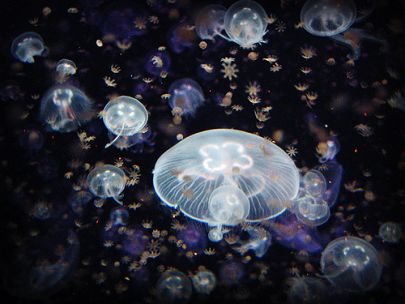
"The Aquarium of the Pacific has commissioned a project that brings art and science together to
translate the movement of sea jellies, or jellyfish, into a symphony...The Symphony of Jellies was developed based on an algorithm that tracks the movements of sea jellies and translates them into sounds...
Marty Quinn, founder of the Design Rythmics Sonification Research Lab, developed software and hardware to capture sea jellies movements with digital video footage and translate them into sounds through a process he calls MoveMusic sonification. Composer Eddie Freeman of Icarus Music used those sounds to create musical motifs and orchestration. Aquarium President and CEO Dr. Jerry Schubel and Aquarium Trustee Dennis Poulsen served as advisors and partners on the project."
Schubel and Quinn are members of the ArtSciConverge effort, and met as participants in the 2015 Reno Workshop.
Hi, Thought this might be of interest for the blog on a collaboration with the Rauschenberg foundation.
=============
Xavier Cortada
Caloosahatchee CLEER (create, learn, exchange, entertain and restore) is a multi modal event to open conversations with the public about the Sanibel Captiva Conservation Foundation's science and policy initiatives while creating community art pieces and listening to three professional singer/songwriters.
The event includes the opportunity to paint wooden message fish to be delivered to Tallahassee, make personal pledges to help clean the water, and enjoy the creation of four iconic art pieces commissioned for the project by Xavier Cortada, an environmental restoration artist.
It has been demonstrated by similar past events, discussing science and policy with residents and visitors in more informal one-on-one festive setting, people delve deeper into the subject of water quality around Sanibel and Captiva. It has also gives SCCF an opportunity to gauge the knowledge people already have and where educational needs may exist.
Musicians for the two November events are J Robert Houghtaling of Marco, Austin Church of Cocoa Beach and Brent Moyer of Nashville TN and Jackson WY.
We have done 3 events like this in the past and people have been great. It is the first time I am putting all the components together after a Communicating Science workshop.
Do artists and scientists actually see different things?
A recent study suggests that what we are capable of perceiving depends on our past experience:
"Music is not only able to affect your mood -- listening to particularly happy or sad music can even change the way we perceive the world, according to researchers from the University of Groningen...
...your brain continuously compares the information that comes in through your eyes with what it expects on the basis of what you know about the world. The final result of this comparison process is what we eventually experience as reality."
Jacob Jolij, Maaike Meurs. Music Alters Visual Perception. PLoS ONE, 2011; 6 (4): e18861 DOI: 10.1371/journal.pone.0018861


 "The Aquarium of the Pacific has commissioned a project that brings art and science together to